The Clinical HEPA Vacuuming Protocol: Eliminating Indoor Allergens from Baseboards
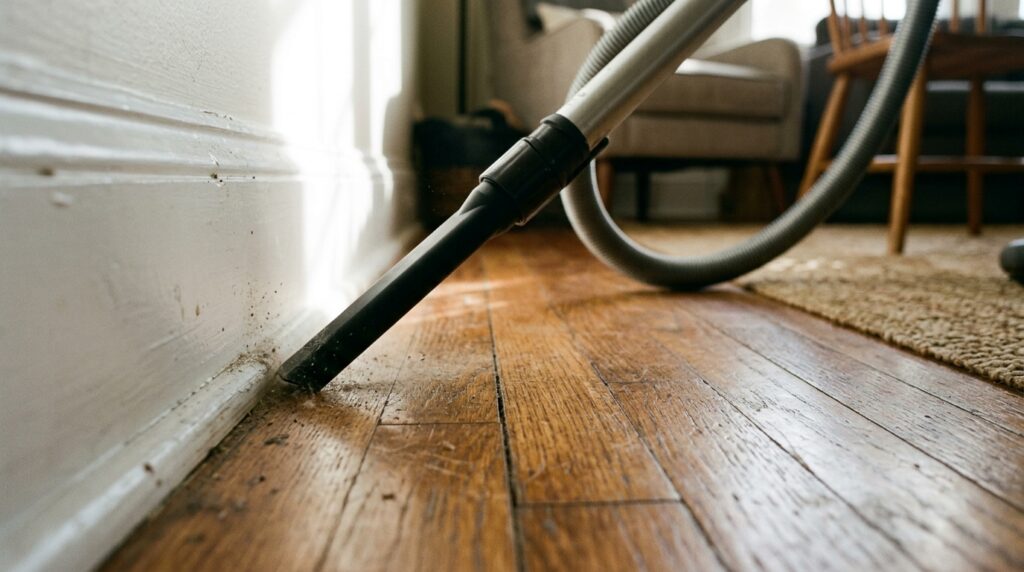
Standard bagless vacuum cleaners create an illusion of cleanliness: while their rotating brushes capture visible pet hair, their unsealed motor housings exhaust millions of sub-micron particles (dust mite fecal pellets, cat dander proteins Der p 1, and fungal spores) back into your breathing zone. Indoor air particulate counts typically spike by 400% during and after poor vacuuming. This clinical protocol captures airborne allergens permanently using true sealed HEPA filtration and perimeter negative-pressure channeling.
Required Equipment & Attachments
- True Sealed-System HEPA Canister Vacuum: 1 unit with genuine multi-ply fleece dust bag.
- Narrow Crevice Tool Attachment: For high-velocity perimeter suction.
- Horsehair Natural Bristle Dusting Brush: (Prevents static cling on baseboards).
- Damp Microfiber Flat Mop: For post-vacuum particulate lockdown.
Step-by-Step Clinical Extraction Protocol
Atmospheric Settling Phase
Never vacuum immediately after dusting furniture or changing bed linens. Allow 30 minutes with windows closed and HVAC circulating for disturbed airborne particulates to settle onto the horizontal floor surfaces before beginning extraction.
Perimeter Crevice Channeling (Baseboards First)
Attach the narrow crevice tool to your vacuum wand. Walk the perimeter of the room, holding the nozzle directly in the corner joint where the baseboard moulding meets the floor. Because room air currents deposit 80% of fine aerosolized allergen particles along wall boundaries, clearing the perimeter first prevents floorhead air exhaust from scattering settled dust.
Slow Overlapping Velocity Floor Passes
Switch to the primary floor tool. Guide the vacuum in slow, deliberate forward-and-back strokes, allowing the motor to draw air through the carpet pile or wood grain for at least 3 seconds per linear yard. Rapid sweeping pushes dirt forward without providing adequate dwell time for negative pressure extraction. Overlap each pass by 50%.
Damp Static Lockdown
Follow immediately behind the vacuum with a flat microfiber mop lightly dampened with plain distilled water. The capillary action of microfibers captures remaining sub-micron electrostatic particles without leaving puddles on hardwood.
Frequently Asked Questions
How often should HEPA exhaust filters be replaced?
True HEPA exhaust filters must be replaced every 12 months (or after 50 operating hours). Over time, fine micro-dust cakes the pleated glass-fiber matrix, reducing suction motor airflow and forcing unsealed gaskets to bypass unfiltered air.
Need Complete Emergency Restoration Sequences?
Get instant access to the Home Rescue Bible with 240+ pages of manufacturer error code maps, chemical ratios, and repair shortcuts.
Download Complete Bible ($39) →