How to Remove Hair Dye from Quartz Countertop Without Ruining the Finish
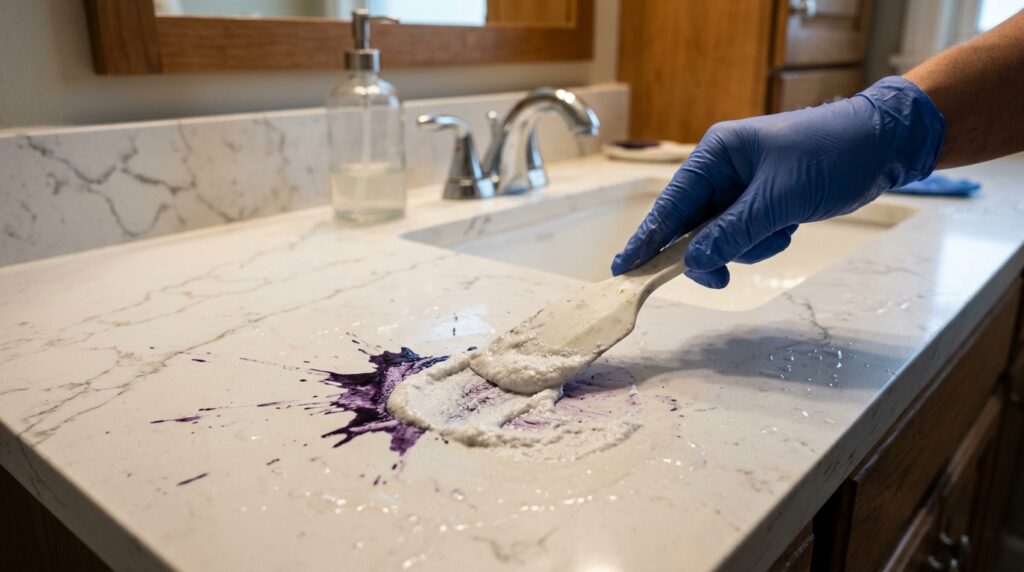
If you dripped permanent hair dye onto your quartz countertop, stop before you reach for nail polish remover or a Magic Eraser. Most online cleaning advice treats engineered quartz like natural granite or solid ceramic tile. That mistake costs homeowners thousands in slab replacements. Here is the exact chemical extraction protocol we use in surface restoration to lift synthetic dye chromophores without stripping the factory gloss or burning the resin binder.
The Chemical & Mechanical Reality: Why Quartz Stains
To understand how to remove hair dye from quartz countertop surfaces safely, you have to understand what engineered quartz actually is. Unlike quarried granite or marble slabs, engineered quartz is a composite material made of roughly 90% to 93% ground mineral silicon dioxide (quartz, Mohs hardness 7) suspended in a binder of 7% to 10% polyester or epoxy resin (Mohs hardness 2.5 to 3.0).
The mineral quartz crystals are non-porous and chemically inert. They do not hold pigment. The vulnerability lies entirely within the polymer resin binder. Modern permanent hair color relies on synthetic oxidation dye precursors—such as p-phenylenediamine (PPD) and resorcinol—suspended in an alkaline vehicle (usually ammonia or ethanolamine, pH 9.5 to 10.5) paired with a hydrogen peroxide developer. When this mixture lands on your counter, the alkaline carrier swells the micro-pores of the polyester resin, allowing microscopic dye chromophores to diffuse deep into the plastic binder. You are not staining stone; you are literally dyeing the countertop’s plastic matrix.
This reality is why typical kitchen cleaning hacks cause irreversible surface destruction when attempting to get permanent hair dye off quartz.
Dismantling the 4 Dangerous Internet Cleaning Myths
In our restoration work, we spend more time repairing the damage caused by bad DIY cleaning advice than treating the original dye mark. Before applying any chemistry, understand why these four popular methods destroy engineered surfaces:
- Myth 1: Acetone (Nail Polish Remover). Acetone is a potent organic solvent. While it liquefies topical dye, it instantly attacks and breaks the cross-linked polymer bonds of polyester and acrylic resins. The result is “resin burn”—a permanent chalky, milky white haze where the top microns of the resin have dissolved. Once resin burn occurs, no chemical polish can restore it; the counter must be mechanically re-machined with diamond pads.
- Myth 2: Melamine Foam (Magic Eraser). Melamine foam is not a soft sponge. It is a rigid formaldehyde-melamine-sodium bisulfite copolymer microstructure that functions exactly like 3,000 to 5,000-grit wet sandpaper. While it barely touches the hard quartz crystals, it shears through the softer resin binder (Mohs 2.5), cutting micro-grooves that permanently destroy the specular surface reflection. You leave behind a dull, matte circle that collects dirt faster than the rest of the slab.
- Myth 3: Distilled White Vinegar or Lemon Juice. Acetic acid (5%) and citric acid lack the solvating strength to break synthetic dye polymers. Even worse, many white and veined quartz slabs incorporate calcium carbonate pigments or crushed limestone fillers. Acids react directly with calcium carbonate, creating calcium acetate salts and micro-etching pitting craters across the surface.
- Myth 4: Chlorine Bleach (Sodium Hypochlorite). Household bleach deactivates dye chromophores by brute oxidation, but it simultaneously degrades polyester chains. On white quartz countertops, hypochlorite oxidation triggers photo-degradation that turns the clear resin binder yellow or brown over time. It swaps a removable dark dye ring for a permanent yellow patch.
Required Chemistry & Tools
To safely pull dye molecules out of the resin phase without altering surface gloss, assemble these exact materials:
- 91% Isopropyl Alcohol (USP Grade): 50 mL. Do not substitute with 70% rubbing alcohol, which contains 30% purified water and lacks sufficient solvent velocity to dissolve unpolymerized topical dye.
- 3% Hydrogen Peroxide (USP Grade): 30 mL. The standard brown bottle found in pharmacies. Never use 20-volume or 40-volume salon developer, which causes uncontrolled oxidative degradation of resins.
- Sodium Bicarbonate (Pure Baking Soda): 45 grams (3 level tablespoons). Acts as an inert, alkaline-buffering wicking substrate.
- Clean White Microfiber Towels (300+ GSM): 3 units. Use undyed white cloths only to prevent cross-transfer of fabric dye during solvent application.
- Polyethylene Food Wrap (Cling Film): 1 square foot. Retards evaporation to create an active osmotic chamber.
- Low-Tack Blue Painter’s Tape: 1 roll (1-inch width). Secures the plastic wrap without leaving acrylic adhesive residue on the quartz.
- Flexible Nylon or Plastic Spatula: 1 unit (1.5-inch width). Never use carbon steel razor blades or metal putty knives, which leave metal marks and chip quartz crystal edges.
- Concentrated pH-Neutral Dish Detergent (Dawn Original): 2 to 3 drops for the final surfactant wash.
The 3-Phase Chemical Extraction Protocol
Immediate Solvent Lift (91% Isopropyl Alcohol Topical Blot)
The moment you detect the stain, your first objective is stripping the unbonded topical carrier film before it continues diffusing into the resin. Fold a clean white microfiber towel into a thick pad. Saturate a 2-inch corner with 15 mL of 91% isopropyl alcohol.
Press the saturated cloth directly onto the dye stain using firm palm pressure for exactly 30 seconds. Do not wipe or scrub horizontally. Lateral scrubbing smears the active dye slurry over unstained resin pores. Lift the cloth straight up. Rotate the towel to an unused dry section and press down firmly to wick up the dissolved pigment. Repeat this vertical blot three times with fresh alcohol until no visible color transfers to the white towel. If a faint shadow remains embedded in the resin, move immediately to Phase 02.
Active Peroxide-Bicarbonate Poultice (Osmotic Draw)
To remove hair dye from quartz countertop with baking soda and peroxide safely, you must formulate an active extraction poultice that forces reverse capillary migration. In a clean glass mixing bowl, measure 45 grams (3 level tablespoons) of sodium bicarbonate. Slowly drizzle in 20 to 25 mL of 3% USP hydrogen peroxide while stirring with a plastic spoon.
Mix until the slurry achieves the homogeneous viscosity of thick Greek yogurt. If the mixture is runny, add a pinch of baking soda; if dry and powdery, add several drops of peroxide. Using your plastic spatula, apply a continuous 1/4-inch (6 mm) layer of paste directly over the stained area, extending the perimeter roughly 1/2 inch beyond the edge of the dye mark.
Lay a sheet of polyethylene food wrap over the wet poultice. Smooth out large air bubbles, then tape down all four edges firmly with low-tack blue painter’s tape. This barrier stops the hydrogen peroxide from evaporating into the room. As the poultice sits for 6 to 10 hours (ideally overnight), the 3% peroxide slowly cleaves the conjugated double bonds of the dye chromophore, rendering it colorless. Simultaneously, the sodium bicarbonate matrix creates an osmotic pressure gradient, drawing the suspended pigment particles up out of the resin pores and trapping them inside the chalky paste.
Mechanical Extraction & pH-Neutral Surfactant Rinse
After 8 hours of dwell time, peel the painter’s tape back slowly at a 45-degree angle. Remove the plastic wrap. The poultice should have transformed into a semi-dry, caked crust containing the extracted dye residue.
Hold your flexible plastic spatula at a shallow 30-degree angle relative to the counter surface. Glide the plastic blade smoothly across the quartz slab, shaving the caked paste into a paper towel. Never chop or pry downward at steep angles. Once the bulk paste is lifted, dampen a clean white microfiber cloth with lukewarm water (roughly 20°C / 68°F) and 2 drops of pH-neutral blue Dawn dish soap. Wipe away all residual sodium bicarbonate dust.
Rinse the cloth thoroughly in clear tap water and wipe the surface a second time to remove all surfactant residue. Finally, take your dry 300 GSM microfiber towel and buff the counter bone-dry with brisk linear strokes. Inspect the surface under direct 4000K daylight or an LED flashlight held at a low oblique angle. The original factory polish will be completely intact with zero trace of dye pigment.
Troubleshooting & People Also Ask (PAA)
Will hair dye stain quartz permanently?
No, hair dye does not stain quartz permanently if treated before harsh abrasives or corrosive solvents ruin the slab. Because 90% to 93% of the slab is impervious mineral quartz, the dye pigment is confined to the upper 5 to 15 microns of the organic polymer binder. A 3% hydrogen peroxide and sodium bicarbonate poultice successfully pulls the synthetic chromophores out of the resin matrix via capillary draw without requiring aggressive sanding or caustic chemicals.
How to remove hair dye from white quartz countertop if it sat overnight?
If hair dye has cured on a white quartz countertop overnight, the unbonded liquid carrier has fully evaporated, locking oxidized pigment into the surface resin. Skip the solvent wipe and go directly to Phase 02. Apply the 3% hydrogen peroxide and baking soda poultice at a 1/4-inch thickness, seal it airtight under plastic wrap, and allow it to draw for a full 10 to 12 hours. On bright white slabs, you may occasionally see a faint yellow shadow after scraping; simply reapply a fresh batch of poultice for a second 6-hour dwell cycle to achieve 100% color elimination.
Can you use Bar Keepers Friend or baking soda directly to scrub hair dye on quartz?
Never scrub dry baking soda or Bar Keepers Friend directly against quartz with a sponge or brush. Bar Keepers Friend contains oxalic acid (which can chemically etch resin fillers) and feldspar abrasive particles rated at Mohs 6.0. While mineral quartz (Mohs 7.0) resists it, the polyester resin binder (Mohs 2.5 to 3.0) is much softer than feldspar. Scrubbing creates thousands of microscopic scratches across the resin, destroying the reflective gloss finish and leaving a permanent dull circle. Baking soda should only be applied as a stationary, motionless wet poultice paste.
Need Complete Emergency Restoration Sequences?
Get instant access to the Home Rescue Bible with 240+ pages of manufacturer error code maps, chemical ratios, and repair shortcuts.
Download Complete Bible ($39) →