How to Remove Melted Plastic from Oven Heating Elements and Racks
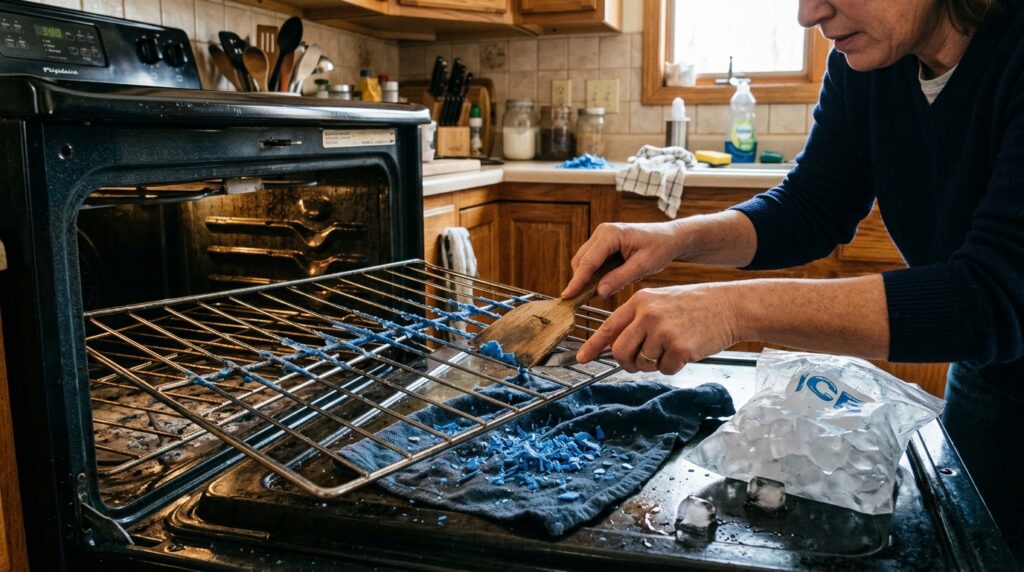
When plastic cutting boards, bread bags, or storage containers contact hot oven surfaces, the polymer chains (polyethylene or polypropylene) melt and fuse into the microscopic surface texture of the Nichrome heating element and chrome-plated racks. Reheating the oven releases toxic volatile organic compounds (VOCs) and charred acrolein vapors. This protocol uses thermal contraction to drop the plastic below its glass transition temperature (Tg), making it brittle enough to chip away cleanly without gouging heating sheaths.
Required Tools & Materials
- Heavy Gallon Freezer Bag filled with Crushed Ice: 1 unit (crushed ice conforms tightly to curved element tubes).
- Beveled Hardwood Wedge or Bamboo Spatula: 1 unit (wood will not gouge nickel-chromium plating).
- Acetone (Pure Technical Grade): 30 mL for dissolving trace polymer residue.
- Heavy Cotton Shop Rags: 2 units.
Step-by-Step Cryogenic Removal Protocol
Apply the Cryogenic Ice Compress
Fill a heavy freezer bag with crushed ice and a splash of cold water to create an ice slush. Lay the bag directly over the fused plastic lump on the heating element or rack. Allow the cold compress to sit for 15 to 20 minutes. As the temperature drops below the polymer’s glass transition point (-20°C to 0°C depending on polymer type), the plastic shrinks faster than the metal beneath it, breaking the mechanical bond.
Fracture & Dislodge the Polymer Chunks
Remove the ice bag and immediately position the edge of your wooden wedge against the base of the plastic lump at a 30-degree angle. Strike the heel of the wooden wedge firmly with your palm. The brittle plastic will fracture and pop off the metal surface in solid pieces. Do not use metal razor blades, putty knives, or screwdrivers on tubular heating elements, as nicking the outer sheath causes premature burnout.
Dissolve Trace Microscopic Residue
Dampen a corner of a cotton shop rag with pure acetone. Vigorously rub any remaining thin plastic film clinging to the metal. Acetone rapidly solvates polystyrene, ABS, and polyolefin residues without reacting with stainless steel or heating alloy sheaths.
Ventilated Burn-Off Cycle
Wipe the element dry with a damp cloth to remove any solvent film. Open the kitchen windows and turn the range hood exhaust on high. Turn the oven on bake at 200°F (95°C) for 10 minutes, then inspect. If zero smoke or odor is detected, the element is fully restored and safe for standard cooking operations.
Frequently Asked Questions
Can I run the self-cleaning cycle to burn off the plastic?
No. Running a high-heat pyrolytic cleaning cycle (800°F+) with bulk plastic inside creates dense black plastic smoke that ruins door gaskets, coats the oven cavity with sticky carbon soot, and can trigger dangerous domestic fire conditions.
Need Complete Emergency Restoration Sequences?
Get instant access to the Home Rescue Bible with 240+ pages of manufacturer error code maps, chemical ratios, and repair shortcuts.
Download Complete Bible ($39) →