How to Remove Super Glue from Granite and Quartz Countertops
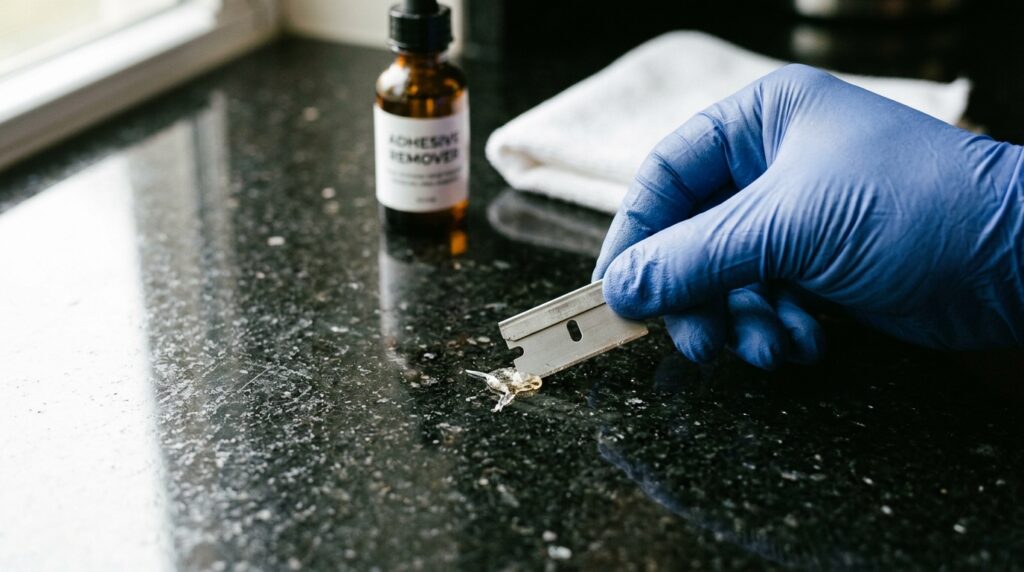
Cyanoacrylate adhesives (Super Glue, Krazy Glue) undergo instant anionic polymerization when exposed to surface moisture, forming rigid acrylic plastic bonds with quartz resin matrices and polished granite pores. Attempting to pry hardened glue with screwdrivers chips the stone, while pouring large pools of acetone can soften the polyester resin binders in engineered quartz. This protocol uses precision solvent softening followed by low-angle blade planing to lift glue drops cleanly.
Required Equipment & Chemistry
- 100% Pure Technical Acetone: 15 mL (do not use oily cosmetic nail polish removers).
- Cotton Swabs (Q-tips): 3 units for targeted micro-application.
- Single-Edge Steel Razor Blade (Brand New, Zero Nicks): 1 unit.
- Mineral Oil or Soapy Water: 10 mL (serves as a lubricating barrier fluid).
- Microfiber Buffing Cloth: 1 unit.
Step-by-Step Low-Angle Planing Protocol
Lubricate the Surrounding Perimeter
Place a drop of mineral oil or soapy water on the counter around the glue droplet. This fluid layer acts as a hydraulic cushion that prevents the blade edges from digging into the stone polish.
Targeted Solvent Softening (90 Seconds)
Dip a cotton swab directly into pure acetone. Press the wet swab tip firmly against the top of the glue mound for 60 to 90 seconds. Keep the acetone strictly confined to the adhesive itself to avoid prolonged solvent exposure to surrounding quartz resin. The cyanoacrylate will soften from glass-hard to rubbery.
Execute the 15-Degree Low-Angle Plane
Hold a fresh single-edge razor blade between your thumb and index fingers. Angle the blade flat against the stone surface at no more than 15 degrees. With steady forward pressure, slide the blade under the softened glue droplet. The glue will shear off in a single clean disc without leaving a shadow.
Clean Residue & Buff
Wipe away the lubricating fluid and glue remnants with a dry microfiber cloth. Clean the stone with mild dish soap and warm water, then buff dry to restore factory gloss.
Frequently Asked Questions
Will acetone ruin my quartz countertop?
Pure acetone applied for 60 to 90 seconds via a cotton swab will not damage quartz resin. Damage only occurs if acetone is pooled across the surface under a rag for 15+ minutes, which causes resin swelling and dull spots.
Need Complete Emergency Restoration Sequences?
Get instant access to the Home Rescue Bible with 240+ pages of manufacturer error code maps, chemical ratios, and repair shortcuts.
Download Complete Bible ($39) →