How to Strip and Reseason Vintage Cast Iron: The High-Smoke-Point Polymerization Guide
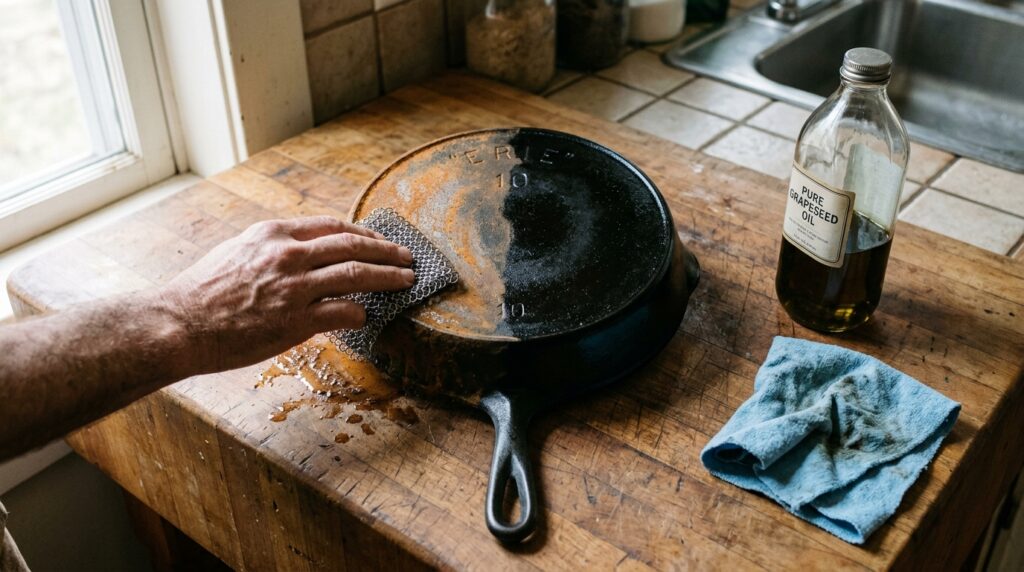
Seasoning on a cast iron pan is not a coating of baked oil; it is a cross-linked polymer matrix formed through lipid polymerization and thermal carbonization. When polyunsaturated fatty acids are heated past their smoke point in contact with bare ferrous iron (which acts as a catalyst), free radicals cross-link the carbon bonds into a slick, hard, non-porous plastic-like coating. This protocol strips surface rust down to the raw iron crystal structure and builds a permanent, non-stick polymerized seasoning layer.
Required Equipment & Chemistry
- Stainless Steel Chainmail Scrubber: 1 unit (strips rust without gouging underlying cast iron).
- Coarse Kosher Salt: 100 grams (serves as an abrasive scouring medium).
- Pure Grapeseed Oil: 30 mL.
- Lint-Free Blue Shop Towels: 3 units (standard paper towels leave white lint fibers).
- Oven with Accurate Temperature Control: Set to 450°F (232°C).
Step-by-Step Polymerization Protocol
Mechanical Rust & Crust Stripping
Pour 100 grams of coarse kosher salt and 20 mL of warm water into the skillet. Use your stainless steel chainmail scrubber to vigorously scrub the cooking surface, sidewalls, and exterior base in firm concentric circles. The salt and chainmail abrade iron oxide flakes down to bare grey metal. Rinse with hot water and inspect.
Complete Stove-Top Desiccation
Cast iron is porous and will develop flash rust within 90 seconds if left to air dry. Immediately place the wet skillet over medium heat on your stovetop for 5 minutes until all moisture has completely evaporated and the pan is uniform matte grey-black.
Micro-Thin Oil Application (The Wipe-Off Law)
Turn off the stove. While the iron is still warm (approx. 200°F), pour half a teaspoon of grapeseed oil onto a blue shop towel and rub it over the entire surface: inside, outside, handle, and bottom. Now take a clean dry shop towel and attempt to wipe all the oil off as if you made a mistake. The only oil layer that should remain is a microscopic film 1 to 2 molecules thick. Leaving visible puddles or drops results in sticky, gummy brown spots that peel off during cooking.
High-Heat Polymerization Bake (450°F / 60 Mins)
Place the skillet upside down on the center rack of your oven (lay a sheet of aluminum foil on the bottom rack to catch any stray droplets). Bake at 450°F (232°C) for 60 minutes. Turn the oven off and allow the skillet to cool inside the oven undisturbed for 2 hours. Repeat steps 3 and 4 two additional times to build a bulletproof, jet-black glass seasoning.
Frequently Asked Questions
Can I use dish soap on cast iron?
Modern dish soaps (like Dawn) are mild synthetic surfactants that do not contain sodium hydroxide (free lye). Washing seasoned cast iron with a soft sponge and dish soap will not harm the cross-linked polymer seasoning. The old myth stems from pioneer lye soaps which dissolved fats and seasoning alike.
Need Complete Emergency Restoration Sequences?
Get instant access to the Home Rescue Bible with 240+ pages of manufacturer error code maps, chemical ratios, and repair shortcuts.
Download Complete Bible ($39) →