
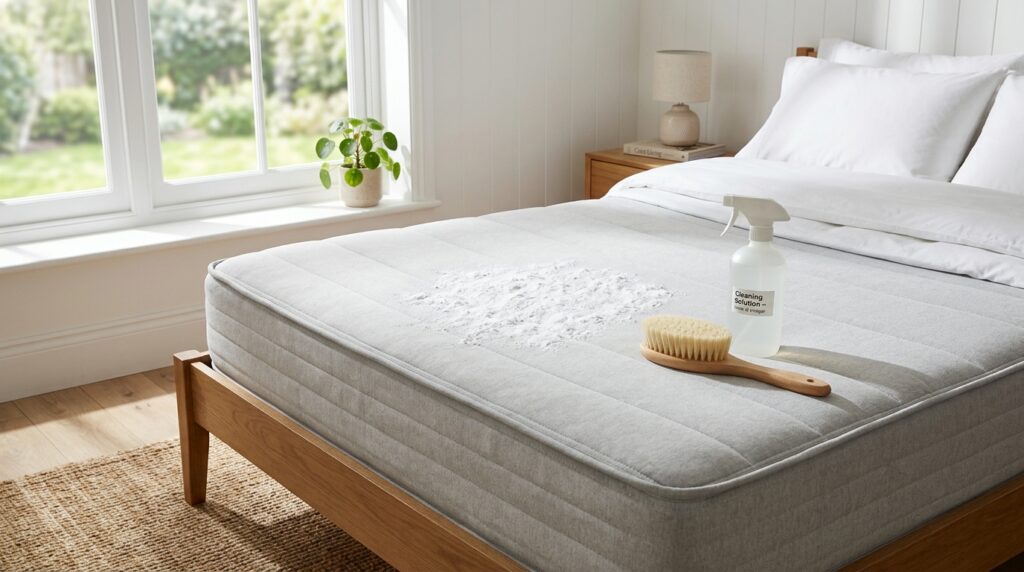
Quick Answer: How to Clean Mattress Stains with Baking Soda
Baking soda is a miracle worker for mattress stains because it naturally lifts moisture, neutralizes odors, and breaks down the proteins in sweat and urine.
- For general odors: Sift a generous layer of baking soda over the entire mattress, wait at least 30 minutes (or up to 24 hours), and vacuum thoroughly.
- For urine & sweat: Spray the area with a 50/50 mix of white vinegar and water. Once dry, apply a paste of baking soda and 3% hydrogen peroxide. Let it dry completely, then vacuum.
- For blood: Dab with 3% hydrogen peroxide and cold water (NEVER hot water). Blot until lifted.
If you are wondering how to clean mattress stains with baking soda, you are in the right place. We spend about a third of our lives in bed, which means our mattresses endure a relentless onslaught of sweat, body oils, dead skin cells, and the occasional late-night snack spill. When you factor in the very real possibility of urine, blood, and the microscopic but horrifying reality of dust mites, it becomes clear that knowing how to effectively clean your mattress is non-negotiable for a healthy home.
Mattresses are notorious for trapping moisture and odors. The dense fibers and deep foam layers create the perfect microclimate for bacteria and fungi to thrive if left unchecked. But before you panic and rush to buy harsh chemical cleaners that will leave toxic residues where you sleep, look in your pantry. Baking soda (sodium bicarbonate) is the absolute gold standard for mattress cleaning. Its mildly alkaline nature (pH of around 8.3) makes it incredibly effective at neutralizing acidic odors (like those from sweat and urine) while its mildly abrasive texture helps physically lift stains without damaging delicate mattress fibers. In this exhaustive guide, we are going to dive deep into every possible stain scenario and show you exactly how to restore your mattress to pristine condition.
🧹 What You Need to Clean Mattress Stains
- 1 box (16 oz) of Arm & Hammer Baking Soda (or similar brand)
- 1 cup of 3% Hydrogen Peroxide (in a dark spray bottle)
- 1 cup of Distilled White Vinegar (5% acidity)
- 2 tablespoons of clear liquid dish soap (like Dawn)
- 1 cup of cold water
- A vacuum cleaner with an upholstery attachment
- Clean, white microfiber cloths or paper towels
- A fine-mesh sieve or flour sifter (for even baking soda application)
- An enzyme-based cleaner (optional, for severe organic stains)
- Why Do Mattresses Get Stained So Easily? The Science Behind the Grime
- How to Remove Urine Stains from a Mattress
- How to Clean Blood Stains from a Mattress
- Eliminating Sweat Stains and Yellowing
- The Ultimate Full-Mattress Deep Clean (Step-by-Step)
- Memory Foam vs. Innerspring Mattresses: Crucial Differences
- Coffee, Wine, and Vomit: The Miscellaneous Disasters
- The Sunlight Method: Nature’s Bleach and Disinfectant
- The Dust Mite Dilemma: Why Baking Soda is Your Best Defense
- Deep Dive: The Chemistry of Odor Removal
- Alternative DIY Mattress Cleaning Solutions
- How Often Should You Clean Your Mattress?
- The Importance of Air Quality and Ventilation
- ❓ Frequently Asked Questions
- Author
Why Do Mattresses Get Stained So Easily? The Science Behind the Grime
Before we treat the stains, it is vital to understand what we are fighting. Every night, the average human loses about 1 to 2 pints of moisture through breathing and sweating. Over a year, that is a staggering amount of fluid seeping into your bedding. Sweat contains water, salt, ammonia, urea, and proteins. When this cocktail hits your mattress, it slowly oxidizes, resulting in the dreaded yellowing that plagues older mattresses.
But moisture isn’t the only culprit. We also shed about 1.5 grams of dead skin cells every single day. These skin cells work their way through your sheets and settle into the mattress fabric, providing a literal all-you-can-eat buffet for dust mites. The droppings from these microscopic arachnids are a primary trigger for allergies and asthma. Add in the oils from your hair and skin, the residue from lotions and cosmetics, and the occasional biological accident (blood, urine, vomit), and your mattress quickly becomes a biological hazard zone.
The reason baking soda is so effective against this specific combination of grime is twofold. First, it is highly highly hygroscopic, meaning it attracts and holds water molecules from the surrounding environment. When you sprinkle it on a mattress, it physically pulls moisture (and the odor-causing compounds dissolved in it) out of the fabric. Second, as an amphoteric compound, it can react with both acids (like uric acid in urine) and bases, neutralizing the pH and eliminating the odors at a molecular level.
How to Remove Urine Stains from a Mattress
Learning how to remove urine stain from mattress fabrics is a rite of passage for parents and pet owners. Urine is particularly insidious because it contains uric acid crystals. Traditional cleaning methods might mask the smell temporarily, but the moment the mattress gets humid, the uric acid crystals reactivate, and the smell returns with a vengeance. This is why you must use a method that breaks down the acid completely.
Step 1: Blot the Excess Moisture. If the stain is fresh, your first priority is to absorb as much liquid as humanly possible. Press dry, white towels into the mattress. Do not rub! Rubbing pushes the urine deeper into the padding. Stand on the towels if necessary to apply maximum pressure. Keep swapping out towels until they come away almost completely dry.
Step 2: The Vinegar Breakdown. Mix 1/2 cup of distilled white vinegar with 1/2 cup of cold water in a spray bottle. Spray the stained area generously, but do not saturate it to the point of dripping. The acetic acid in the vinegar breaks down the uric acid in the urine. Let this sit for 10-15 minutes, then blot again with clean towels to remove the excess moisture.
Step 3: The Baking Soda and Peroxide Paste. While the area is still slightly damp from the vinegar, sprinkle a thick layer of baking soda entirely over the stain. Next, mix 1/2 cup of 3% hydrogen peroxide with 1 teaspoon of clear liquid dish soap. Gently spray or dab this mixture over the baking soda. You will see it begin to foam—this is the chemical reaction of oxygen being released, which lifts the stain to the surface while the baking soda absorbs it.
Step 4: Wait and Vacuum. This is the hardest part: wait. You must leave this mixture on the mattress until it is 100% bone dry. This can take anywhere from 8 to 24 hours depending on your climate and ventilation. Pointing a fan at the mattress will speed up the process. Once completely dry and crusty, use the upholstery attachment on your vacuum to thoroughly suck up the baking soda residue. The stain and the smell should be completely gone.
For older, set-in urine stains, particularly from cats, you may need to escalate to a commercial enzyme cleaner. Enzymes are biological catalysts that literally digest the proteins and uric acid. For a great DIY solution for related odors, check out our guide on the natural pet odor carpet stain eraser recipe.
How to Clean Blood Stains from a Mattress
Blood is a protein-based stain, and protein stains have one absolute, unbreakable rule: NEVER use hot water. Hot water literally cooks the proteins, causing them to bind permanently to the fibers of your mattress. Once a blood stain is “set” with heat, it is nearly impossible to remove entirely. The key to removing blood is cold water and oxygenation.
Step 1: The Cold Water Dab. If the blood is fresh, lightly dampen a clean cloth with freezing cold water and gently dab the spot. Do not rub. You are trying to lift the blood straight up.
Step 2: The Peroxide Attack. Hydrogen peroxide (3%) is the undisputed champion for blood stains. Apply a small amount directly to the stain. It will immediately begin to fizz and bubble. This is the extra oxygen molecule breaking the chemical bonds of the blood. Let it bubble for a minute, then blot away the foam with a clean cloth. Repeat this process until the stain fades.
Step 3: The Baking Soda Finish. Because peroxide introduces moisture, you need to draw that moisture out to prevent mildew. Sprinkle a thick layer of baking soda over the damp area. The baking soda will absorb the remaining liquid and any lingering pigment that the peroxide brought to the surface. Leave it for at least 4 hours, then vacuum it away.
If the blood stain is old and brown, you can make a paste of 1/2 cup baking soda, 1/4 cup hydrogen peroxide, and 1 tablespoon of salt. The salt adds mild abrasion and helps dehydrate the proteins. Rub this paste gently into the stain, let it dry completely, scrape off the crust, and vacuum. You might need to repeat this twice for very old stains.
⚠️ What NOT to Do When Cleaning a Mattress
- NEVER soak the mattress: Foam and inner layers can take weeks to dry if fully saturated, leading to massive mold and mildew growth deep inside the bed. Always use minimal liquid.
- NEVER use hot water on organic stains: Hot water permanently sets protein stains like blood, sweat, and urine.
- NEVER use bleach: Chlorine bleach can destroy the synthetic fibers of your mattress cover and leave toxic fumes trapped in your sleeping environment.
- NEVER use a steam cleaner on memory foam: The intense heat will literally melt the cellular structure of memory foam, destroying its supportive properties forever.
- NEVER rub or scrub vigorously: This damages the ticking (the outer fabric) and pushes stains deeper into the padding. Always blot and dab gently.
Eliminating Sweat Stains and Yellowing
Over time, almost all mattresses develop a yellowish hue. This is the cumulative result of thousands of hours of sweat oxidizing in the fabric. While it looks terrible, it is entirely treatable with our trusty combination of baking soda, peroxide, and dish soap.
Create a heavy-duty stain remover spray by combining 1 cup of 3% hydrogen peroxide, 3 tablespoons of baking soda, and 1 teaspoon of clear dish soap in a spray bottle. Note: Do not make this mixture ahead of time. The chemical reaction produces oxygen gas, which can cause a sealed bottle to burst. Mix it right before you need it.
Lightly mist the yellowed areas of the mattress. The dish soap acts as a surfactant, breaking the surface tension of the oils in the sweat so the peroxide and baking soda can penetrate deeply. Use an old, clean toothbrush or a soft-bristled scrub brush to gently work the solution into the fabric using small circular motions. Let it sit for 30 minutes, then wipe the area with a cloth barely dampened with plain cold water. Finally, coat the area in dry baking soda to pull out the remaining moisture, let dry, and vacuum.
The Ultimate Full-Mattress Deep Clean (Step-by-Step)
Sometimes you don’t just have one stain; you need to refresh the entire bed. If your mattress smells a bit stale or you’re doing your seasonal deep cleaning, the dry baking soda method is exactly what you need. This is how you perform a comprehensive mattress detox.
Step 1: Strip and Wash. Remove all bedding—sheets, blankets, mattress protectors, and pillows. Wash them all in the hottest water the fabric care labels allow. This kills dust mites lingering in the bedding.
Step 2: The Initial Vacuum. Using the upholstery attachment, vacuum the entire surface of the mattress. Pay special attention to the seams and crevices around the edges, as this is where dust mites, dead skin, and dirt accumulate. Use slow, overlapping strokes to pull up as much debris as possible.
Step 3: The Sieve Method. Take your 16 oz box of Arm & Hammer baking soda and pour it into a fine-mesh kitchen sieve. This is the secret to an even application. Sift the baking soda heavily over the entire surface of the mattress. If you want to add a relaxing scent, mix 10-15 drops of lavender or eucalyptus essential oil into the baking soda before sifting. The essential oils also have mild antibacterial properties.
Step 4: The Waiting Game. The longer you leave the baking soda, the better it works. One hour is the absolute minimum, but leaving it for 24 hours is ideal. If possible, open the windows in the bedroom. Sunlight contains UV rays that naturally disinfect the mattress and help bleach out light stains. The fresh air also helps dry out any latent moisture trapped in the foam.
Step 5: The Final Extraction. Vacuum the mattress again, moving very slowly to ensure you extract every last grain of baking soda. The powder will have absorbed odors, oils, and moisture, leaving your mattress smelling incredibly fresh and clean. If you’re dealing with similar deep-cleaning challenges on carpets, you’ll want to read our guide on how to clean dirty rug carpet stains with baking soda and vinegar.
Memory Foam vs. Innerspring Mattresses: Crucial Differences
Not all mattresses are created equal, and you must adjust your cleaning technique based on the material. Innerspring mattresses are more forgiving. Their open coil structure allows for greater airflow, meaning they dry faster. However, the metal coils can rust if water seeps too deep, so you still want to avoid over-wetting.
Memory foam mattresses, on the other hand, require extreme caution. Memory foam is basically a giant sponge. If you pour liquid onto it, it will absorb it instantly and hold onto it forever. Because the cellular structure of the foam is so dense, air cannot circulate properly to dry out the core. A wet memory foam mattress is a guaranteed mold factory. When cleaning memory foam, you must rely almost entirely on dry methods (like the heavy baking soda sift) or extremely lightly applied foams. Never spray liquid directly onto a memory foam bed; spray it onto a cloth first, then dab.
Coffee, Wine, and Vomit: The Miscellaneous Disasters
Life happens, and sometimes you end up with breakfast in bed gone wrong or a sick child in the middle of the night. For vomit, you must first remove the solids with a paper towel. Then, tackle the odor and acidity immediately with a 50/50 vinegar and water spray. Let it sit, blot dry, and apply a massive pile of baking soda to neutralize the intense stomach acids.
For coffee and wine (tannin stains), skip the peroxide initially. Instead, mix 2 tablespoons of clear dish soap with 1 cup of cold water. Blot the stain from the outside in (to prevent spreading). Once the color lifts, apply vinegar to neutralize the soap, blot again, and finish with baking soda to pull out the moisture.
🛡️ Maintenance & Prevention Strategy
Cleaning a mattress is hard work. The easiest way to keep your mattress clean is to prevent it from getting dirty in the first place.
- Invest in a waterproof mattress protector: This is non-negotiable. Modern protectors are breathable, silent, and completely block moisture, dead skin, and dust mites from reaching the mattress.
- Wash sheets weekly: Wash your bedding in hot water every 7 days to remove the buildup of skin cells and sweat before they can seep downward.
- Air it out: Every time you change your sheets, leave the bed bare for 30-60 minutes to let the mattress breathe and release trapped moisture.
- Flip or Rotate: Rotate your mattress 180 degrees every 3-6 months to prevent body indentations. Note: most modern foam mattresses are one-sided and should not be flipped, only rotated.
The Sunlight Method: Nature’s Bleach and Disinfectant
If you have a portable mattress or a lightweight foam topper, taking it outside into direct, blazing sunlight is one of the most effective, completely free cleaning methods available. The ultraviolet (UV) radiation from the sun is a natural, powerful disinfectant. UV light damages the DNA of bacteria, viruses, and dust mites, effectively sterilizing the surface of the mattress without a single drop of chemicals.
Furthermore, the sun acts as a natural bleaching agent. If you have treated a yellow sweat stain or an old blood stain and there is still a faint shadow left behind, placing the mattress in the sun for 4 to 6 hours can often fade the remaining pigmentation to the point of invisibility. The heat from the sun and the cross-breeze of outdoor air will also evaporate any deep-seated moisture that might be harboring musty odors. If you cannot take the mattress outside, simply opening your bedroom windows and throwing back the curtains to let direct sunlight hit the bare mattress for several hours a day is a highly recommended practice.
The Dust Mite Dilemma: Why Baking Soda is Your Best Defense
We need to talk about dust mites. It is an unpleasant reality, but every single mattress, no matter how clean the home, harbors dust mites. These microscopic cousins of the spider feed exclusively on the dead skin flakes that humans and pets shed daily. A typical used mattress can house anywhere from 100,000 to 10 million mites inside. They prefer warm, dark, and humid environments, which perfectly describes the interior of a mattress occupied by a sleeping human.
The problem is not the mites themselves—they do not bite or transmit diseases. The issue is their waste products. Dust mite feces contain a protein called Der p 1, which is a highly potent allergen. When you move in your sleep, you disturb the microscopic dust, sending these allergens into the air where you inhale them. This is a primary cause of morning congestion, itchy eyes, asthma flare-ups, and skin conditions like eczema.
Baking soda is a brilliant, non-toxic weapon in the war against dust mites. While it doesn’t necessarily kill them on contact like a toxic pesticide would, it severely disrupts their habitat. Dust mites absorb moisture from the air to survive; they do not drink water. By laying down a thick coating of highly hygroscopic baking soda, you dramatically reduce the localized humidity on the surface of the mattress. The baking soda desiccates (dries out) the environment, making it incredibly hostile for the mites to thrive and reproduce. When combined with rigorous vacuuming with a HEPA filter, the baking soda method physically removes the food source (dead skin), the allergens (feces), and many of the mites themselves.
Deep Dive: The Chemistry of Odor Removal
Why exactly does baking soda work so much better than commercial air fresheners? It comes down to basic chemistry. Most commercial sprays merely mask odors. They contain strong synthetic fragrances that overpower the bad smells and cyclodextrins that trap odor molecules temporarily. However, once the fragrance fades or the moisture returns, the bad smell is right back where it started.
Baking soda, chemically known as sodium bicarbonate (NaHCO3), actually changes the chemical structure of the odor-causing compounds. Most of the offensive smells trapped in a mattress are either highly acidic or highly basic. For example, sour sweat and vomit contain butyric acid and other volatile fatty acids. Urine breaking down produces ammonia, which is a strong base.
Sodium bicarbonate is an amphoteric substance. This means it can react as both an acid and a base depending on what it comes into contact with. When it meets the acidic compounds in sweat, it neutralizes them into harmless, odorless salts and water. When it encounters basic ammonia from old urine, it neutralizes that as well. It physically alters the pH of the odor molecules, rendering them completely inert. They don’t just smell better; they literally cease to exist as odor-causing compounds. This is why a heavy application of baking soda, left to work its chemical magic over 24 hours, is more effective than the most expensive commercial fabric sprays.
Alternative DIY Mattress Cleaning Solutions
While baking soda, vinegar, and hydrogen peroxide form the holy trinity of mattress cleaning, there are a few other household items you can enlist if you find yourself in a pinch.
1. Club Soda: For fresh liquid spills (like wine or juice), club soda is incredibly effective. The carbonation provides a gentle bubbling action that helps lift the pigment out of the fibers before it can set. Pour a small amount directly onto the fresh spill and immediately blot with a dry towel.
2. Cornstarch: If you are out of baking soda, cornstarch is an excellent substitute for absorbing grease and oil-based stains (like body lotions, massage oils, or food grease). It doesn’t have the same odor-neutralizing chemical properties as baking soda, but it is highly absorbent. Sprinkle it heavily over a greasy stain, let it sit for a few hours to pull the oil out of the fabric, and vacuum.
3. Borax: For extremely tough odors or persistent mildew smells, Borax (sodium tetraborate) can be used. It is more alkaline than baking soda and has stronger fungicidal properties. However, it is also harsher and can be an irritant to skin and eyes. Use it sparingly, ensuring you vacuum it up completely, and avoid using it if you have infants or pets that sleep in the bed.
How Often Should You Clean Your Mattress?
Mattress maintenance should be built into your regular home cleaning schedule, not just reserved for emergencies when a stain occurs. We recommend a proactive approach.
Weekly: Strip the bed and wash all sheets and pillowcases in hot water. Leave the mattress bare for an hour to air out.
Monthly: When you strip the bed, take 5 minutes to vacuum the surface of the mattress with the upholstery tool. This removes the surface layer of dead skin and dust before it gets ground deeply into the fabric.
Every 3 to 6 Months: Perform the full baking soda deep clean. Sift the baking soda over the entire surface, leave it for a few hours, and vacuum. This is also the time to rotate the mattress 180 degrees to ensure even wear and prevent sagging.
Every 5 to 7 Years: Evaluate if the mattress needs replacing. Even with meticulous cleaning, the foam structures break down, springs lose their tension, and allergens inevitably build up deep within the core where no vacuum can reach. If you are waking up with aches and pains, or if your allergies are significantly worse at night, it might be time to retire the mattress regardless of how clean the surface looks.
The Importance of Air Quality and Ventilation
Cleaning the mattress is only half the battle; maintaining a healthy sleeping environment is the other half. The climate in your bedroom directly impacts how quickly your mattress accumulates moisture and bacteria. If your bedroom is constantly humid, your mattress will act like a giant sponge, pulling moisture from the air. This creates a breeding ground for mold and dust mites.
Aim to keep your bedroom humidity below 50%. Running a dehumidifier during sticky summer months can drastically extend the life of your mattress. Additionally, ensure good airflow. Leaving the bedroom door open during the day and running a ceiling fan helps circulate the air, preventing stagnant moisture from settling on the bed. A well-ventilated room also allows any lingering odors from previous spills or cleaning treatments to dissipate much faster.
By understanding the science of stains, the chemistry of natural cleaners like baking soda, and the necessity of preventative care, you can ensure your mattress remains a pristine, hygienic sanctuary for years to come. Do not let spills, sweat, or biological accidents ruin your investment. Armed with a box of baking soda and a bit of patience, you have everything you need to conquer even the most stubborn mattress stains.
❓ Frequently Asked Questions
Can I sleep on a mattress with baking soda on it?
No, it is highly recommended that you vacuum up all the baking soda before sleeping. If left on, it will feel gritty, dry out your skin, and you risk inhaling the fine powder while you sleep, which can irritate your lungs.
How long does it take for hydrogen peroxide to dry on a mattress?
It depends on how heavily it was applied and the room’s ventilation, but generally, it takes 2 to 4 hours. Pointing a fan directly at the wet spot will significantly speed up the evaporation process.
Does baking soda ruin a vacuum cleaner?
If you have a modern vacuum with a HEPA filter, the fine particles of baking soda can clog the filter prematurely if you vacuum up massive piles of it constantly. For standard mattress cleaning, it is fine, but be sure to clean or replace your vacuum filters frequently to maintain suction power.
Will vinegar leave a permanent smell on my mattress?
No. While wet vinegar has a very pungent, sour smell, acetic acid evaporates completely as it dries. Once the spot is 100% dry, the vinegar smell will vanish entirely, taking the bad odors with it.
How do you get a pee stain out of a mattress without vinegar?
If you cannot stand the smell of vinegar, your best alternative is a dedicated commercial enzymatic cleaner. Enzymes literally digest the uric acid without the acidic smell of vinegar. Follow the bottle instructions, usually involving saturating the stain and covering it with a damp towel to let the enzymes work.
Can I use a hair dryer to dry a wet mattress?
Use extreme caution. A hair dryer on the ‘cool’ or ‘warm’ setting is fine to speed up surface drying. NEVER use the ‘hot’ setting, especially on memory foam, as it can melt the foam structure or permanently set a protein stain that hasn’t been completely washed out.
Is it worth getting a mattress professionally cleaned?
If your mattress is severely soiled, has deep set-in pet urine odors, or suffered from a massive liquid spill that soaked deep into the core, professional steam extraction (performed correctly to avoid over-wetting) is worth the cost to save an expensive mattress.
✅ The Bottom Line
You do not need toxic, expensive chemicals to maintain a hygienic bed. Knowing how to clean mattress stains with baking soda, vinegar, and hydrogen peroxide empowers you to tackle everything from routine sweat yellowing to emergency blood and urine stains. Remember the golden rules: never use hot water on protein stains, avoid soaking the mattress, and let the baking soda sit for as long as possible to maximize its odor-absorbing magic. Protect your investment with a quality waterproof cover, and your mattress will provide clean, comfortable sleep for years.