Quick Answer
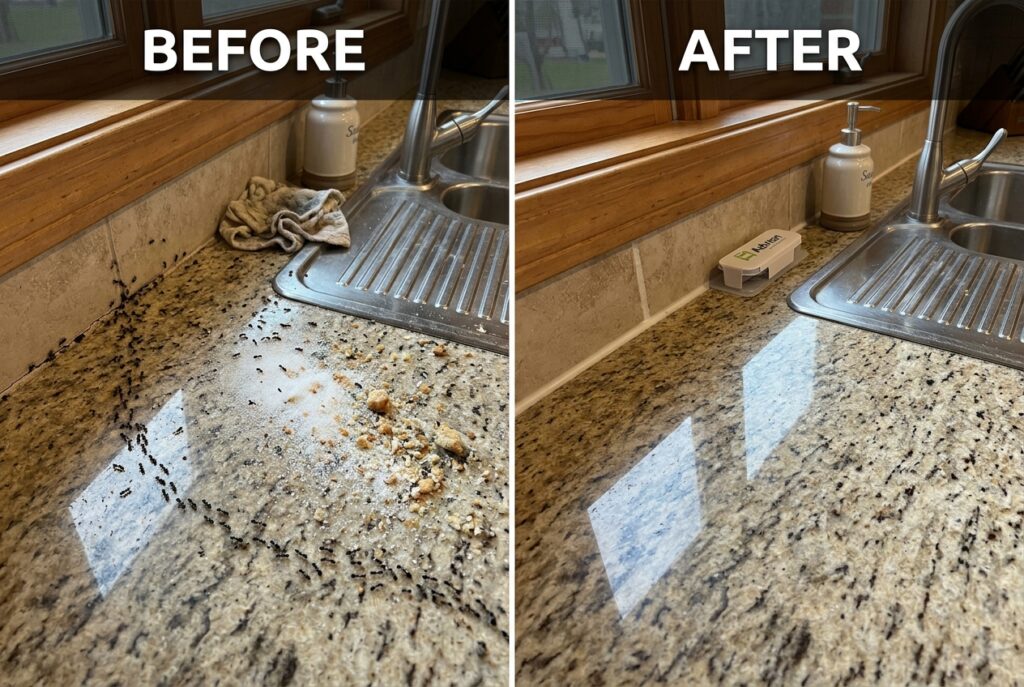
Kill the colony, not just the ants you see. A homemade borax and sugar bait is the most effective DIY method — worker ants carry the poison back to the queen, eliminating the entire colony within 5 to 10 days. Combine with vinegar trail erasure and entry point sealing for a permanent solution.
You see a line of ants on your kitchen counter. You spray them. They die. You feel like you solved the problem. Then 24 hours later, there is a new line in the exact same spot — or worse, a different spot entirely. Sound familiar?
Here is why killing visible ants does not work: the ants you see represent less than 10% of the colony. They are foragers — expendable workers whose job is to find food and report back. The queen, who produces up to 800 eggs per day, is safely hidden in a nest that could be inside your walls, under your foundation, or in your yard. As long as she is alive, she replaces every worker you kill within hours.
💡 The Science: Ants navigate using pheromone trails — chemical signals they deposit as they walk. When a forager finds food, it leaves a pheromone path from the food source back to the nest. Every ant that follows the trail reinforces it, making it stronger. This is why ants always walk in a line and why they keep coming back to the same spot. Killing the ants does not erase the trail. You need to destroy the pheromone signal AND eliminate the queen.
- 🧹 What You Need
- Step 1: Identify the Ant Trails (Do Not Kill Them Yet)
- Step 2: Make the Borax Bait
- Step 3: Wait 5 to 10 Days (And Expect More Ants at First)
- Step 4: Erase the Pheromone Trails with Vinegar
- Step 5: Seal Entry Points Permanently
- Step 6: Set Up a Perimeter Defense
- ⚠️ What Not to Do
- How to Keep Ants Gone Permanently
- ❓ FAQ
- ✅ Bottom Line
- 📖 Related Cleaning Guides
- Author
🧹 What You Need
- 🔹 Borax (sodium borate) — slow-acting stomach poison that worker ants carry back to the colony. Available at any grocery store in the laundry aisle (20 Mule Team Borax is the most common brand).
- 🔹 Granulated sugar — the attractant. Ants are hardwired to seek glucose and will choose sugar over almost any other food source.
- 🔹 Peanut butter (optional) — some ant species prefer protein and fat over sugar. Having both types of bait covers all species.
- 🔹 White vinegar — acetic acid destroys pheromone trails on contact
- 🔹 Small lids or cardboard squares — bait stations
- 🔹 Caulk or silicone sealant — for sealing entry points
- 🔹 Diatomaceous earth (food grade) — mechanical insecticide for perimeter defense
Step 1: Identify the Ant Trails (Do Not Kill Them Yet)
This is the hardest part for most people — you need to resist the urge to kill or spray the ants you see. Instead, watch them. Follow the trail in both directions. Find where they are entering your home (usually a crack in the baseboard, a gap around a pipe, or a window seal) and where they are heading to (usually a food source).
You want the trail active because these foragers are going to become your delivery system. They will carry the borax bait directly to the queen.
💡 Pro Tip: If you cannot find the entry point, place a small drop of honey on a piece of paper near where you see ants. Within 30 minutes, a trail will form, and you can trace it back to the source.
Step 2: Make the Borax Bait
Mix 1 tablespoon of borax with 3 tablespoons of sugar and enough warm water to dissolve everything into a syrup. Stir until the borax is completely dissolved — any visible crystals will deter ants from eating it.
Soak cotton balls in the syrup and place them on small lids or cardboard squares directly on the ant trail — as close to the entry point as possible.
For protein-loving ants (if they ignore the sugar bait), make a second bait: mix 1 teaspoon of borax with 2 tablespoons of peanut butter. Place both types of bait side by side.
💡 The Science: Borax (Na₂B₄O₇·10H₂O) works through two mechanisms. First, when ingested, it disrupts the ant’s digestive enzymes, causing slow starvation over 2 to 3 days — slow enough that the worker returns to the nest and feeds the poison to larvae and the queen through trophallaxis (mouth-to-mouth food sharing). Second, borax crystals are abrasive to the ant’s exoskeleton, damaging the waxy cuticle and causing dehydration. The 1:3 borax-to-sugar ratio is critical — too much borax kills ants before they reach the nest; too little does not deliver a lethal dose to the colony.
❌ Common Mistake: Using too much borax. If ants die on the way back to the nest, the bait is too strong. Reduce the borax to a 1:4 ratio. The goal is slow death — not immediate kill.
Step 3: Wait 5 to 10 Days (And Expect More Ants at First)
After placing the bait, you will likely see MORE ants in the first 2 to 3 days. This is actually a great sign — it means the foragers have found your bait and are recruiting more workers to collect it. They are literally spreading the word that they found an amazing food source.
Do not disturb the bait. Do not spray. Do not wipe the trails. Let the ants do the work for you. They are carrying borax directly into the heart of the colony and feeding it to every member, including the queen and larvae.
By day 4 to 5, you should notice fewer ants. By day 7 to 10, the trail should stop entirely. If the queen is dead, no new workers are being produced, and the colony collapses.
Step 4: Erase the Pheromone Trails with Vinegar
Once ant activity stops, it is time to erase the chemical highways they left behind. Mix equal parts white vinegar and water in a spray bottle and spray every surface where you saw ant trails — countertops, baseboards, window sills, floor edges.
Wipe thoroughly with a cloth. The acetic acid in vinegar breaks down the pheromone molecules, destroying the scent trail completely. Without the trail, any surviving ants from nearby colonies cannot find the route into your home.
💡 The Science: Ant pheromones are volatile organic compounds — primarily hydrocarbons and fatty acid esters. Vinegar’s acetic acid denatures these molecules through acid hydrolysis, rendering them undetectable to ant antennae. A single thorough wipe eliminates a trail that took hundreds of ants days to establish.
Step 5: Seal Entry Points Permanently
Now that the colony is dead and the trails are erased, seal every entry point you identified in Step 1. Use silicone caulk for cracks in walls, baseboards, and window frames. Use steel wool + caulk for gaps around pipes.
Check these common ant entry points:
- Where plumbing pipes enter through walls
- Window frames and door frames with gaps
- Baseboards with visible cracks
- Electrical outlet covers on exterior walls
- Where the foundation meets the siding outside
Step 6: Set Up a Perimeter Defense
Sprinkle a thin line of food-grade diatomaceous earth (DE) along the outside perimeter of your home — at the base of exterior walls, around door thresholds, and near any cracks in the foundation. DE is made of fossilized diatom shells with microscopic razor-sharp edges that cut through the waxy cuticle on an ant’s exoskeleton, causing fatal dehydration.
Reapply after rain. DE is non-toxic to humans and pets (food grade only) but lethal to any crawling insect that walks through it.
💡 The Science: Diatomaceous earth works through mechanical action, not chemical poison. The silica particles are 10 to 200 micrometers in size — too small to harm mammals but devastating to insects. Each particle acts like a microscopic blade, lacerating the exoskeleton’s lipid layer and causing the ant to lose moisture through evaporation. Death occurs within 24 to 48 hours of contact. Because it is mechanical, ants cannot develop resistance to it — unlike chemical pesticides.
⚠️ What Not to Do
- Do not spray insecticide on ant trails — it kills foragers before they can carry bait back to the colony, which is counterproductive
- Do not use too much borax in the bait — if ants die immediately, they never reach the queen. Use a 1:3 ratio maximum
- Do not clean up the bait stations for at least 10 days — even if you stop seeing ants, the colony may still be collapsing
- Do not use pool-grade diatomaceous earth — it is heat-treated and contains crystalline silica that is harmful when inhaled. Only use food-grade DE
- Do not leave pet food bowls out overnight — this is one of the top 3 ant attractants in any home
- Do not squash ants on the trail — crushed ants release oleic acid alarm pheromones that recruit more ants to investigate
How to Keep Ants Gone Permanently
- Wipe counters every night — even invisible crumbs and grease films attract ants. Use vinegar spray for the pheromone-erasing bonus
- Store all food in sealed containers — ants can detect sugar through cardboard and thin plastic bags
- Take out trash daily — especially in summer when ant activity peaks
- Fix moisture sources — ants need water. Fix leaky faucets, dry under-sink areas, and ensure no standing water anywhere
- Trim vegetation touching your house — branches and shrubs act as ant highways from outdoor colonies to your walls
- Refresh DE perimeter every 2 to 4 weeks and after any rainfall
- Keep borax bait stations near entry points year-round as an early warning and prevention system
❓ FAQ
How long does it take for borax bait to kill a colony?
Most colonies collapse within 5 to 10 days. Large colonies with multiple queens (like Argentine ants) may take up to 3 weeks. If you are still seeing heavy activity after 2 weeks, increase the number of bait stations or try the peanut butter bait variant.
Is borax safe around kids and pets?
Borax is low-toxicity but should not be ingested. Place bait stations behind appliances, inside cabinets, or under furniture — places ants travel but children and pets do not reach. If you have curious pets, use enclosed bait stations (a small container with a hole small enough for ants but not paws).
Why are the ants ignoring my bait?
Different species prefer different foods. If ants ignore the sugar bait, switch to peanut butter + borax or try honey instead of sugar. Grease ants and carpenter ants often prefer protein and fat over sweets. Also make sure there is no competing food source nearby — seal all other food first so the bait is the most attractive option.
Does cinnamon or peppermint oil actually repel ants?
They provide temporary deterrence — ants will avoid the scent for a few hours but simply reroute around it. Essential oils do not kill ants or destroy colonies. They mask pheromone trails briefly but the ants re-establish new trails. Use vinegar instead — it actually breaks down the pheromone molecules rather than just covering the scent.
What if the ants are coming from inside my walls?
Place borax bait directly at the wall entry point. The ants will carry it inside and feed the colony. If you suspect carpenter ants (large, black, active at night, sawdust piles near baseboards), call a professional — carpenter ants tunnel through wood framing and can cause structural damage if left untreated.
✅ Bottom Line
Killing visible ants is a waste of time — the queen replaces them faster than you can spray. The permanent solution is a three-phase approach: (1) borax bait that foragers carry back to poison the entire colony including the queen, (2) vinegar to destroy the pheromone trail network, and (3) caulk and diatomaceous earth to seal and defend the perimeter. This combination attacks the colony’s biology, communication system, and access points simultaneously. Follow this method and ants will not come back.