Quick Answer
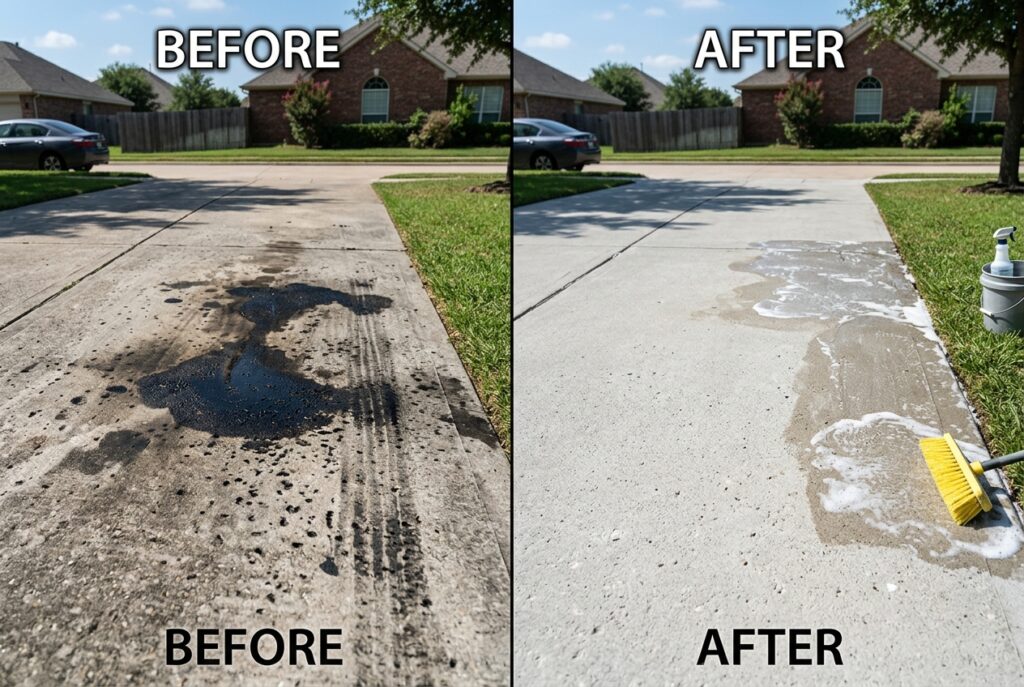
To remove oil stains from a concrete driveway: First absorb fresh oil with cat litter or baking soda for 30 minutes. Then make a thick paste with 1 cup Baking Soda, 3 tbsp Dawn Dish Soap, and 2-3 tbsp warm water. Spread the paste over the stain, cover with plastic wrap, and let it dwell for 1 to 2 hours (overnight for old stains). Spray with 1 cup White Vinegar to trigger a carbonation fizzing reaction, scrub vigorously with a stiff deck brush, and rinse with a garden hose or pressure washer. Repeat for deep, set-in stains.
A dark, spreading motor oil stain on your concrete driveway is one of the most stubborn and unsightly problems a homeowner can face. Whether it came from a slow engine leak, a transmission fluid drip, a hydraulic line failure, or a messy oil change, petroleum-based fluids penetrate deep into the porous structure of concrete within minutes. The longer the oil sits, the deeper it wicks into the microscopic capillaries of the cement matrix, turning a small drip into a permanent-looking black shadow that no amount of rain or garden hose rinsing can wash away.
Oil-stained driveways are more than an eyesore — they reduce curb appeal and property value, create slippery hazards when wet, attract dirt and debris that bonds to the sticky residue, and can leach petroleum compounds into storm drains and groundwater. Many homeowners assume that once motor oil has soaked into concrete, the stain is permanent. That is not true.
The key to removing oil from concrete is understanding that you need to reverse the absorption process. You need a cleaning agent that can penetrate into the same pores the oil occupied, emulsify and break down the hydrocarbon molecules, and draw them back out to the surface where they can be scrubbed and rinsed away. The combination of baking soda, Dawn dish soap, and white vinegar accomplishes exactly this through three complementary chemical mechanisms.
- Why Oil Stains Are So Difficult to Remove from Concrete
- 🧹 What You Need
- Step 1: Absorb Fresh Oil Immediately (For New Spills)
- Step 2: Mix the Oil-Pulling Degreasing Paste
- Step 3: Apply the Paste & Cover for Extended Dwell
- Step 4: Spray Vinegar for Fizzing Extraction
- Step 5: Scrub Aggressively & Rinse
- Step 6: Repeat for Stubborn Set-In Stains
- ⚠️ What Not to Do
- Long-Term Prevention & Driveway Care
- ❓ FAQ
- ✅ Bottom Line
- 📖 Related Cleaning Guides
- Author
Why Oil Stains Are So Difficult to Remove from Concrete
Concrete is not a solid, impermeable surface — it is a porous matrix of calcium silicate hydrate crystals, sand aggregate, and millions of microscopic air pockets and capillary channels. When liquid motor oil contacts concrete, capillary action draws the low-viscosity petroleum deep into these channels, similar to how a paper towel absorbs water.
Once inside the pores, the oil undergoes several changes that make removal increasingly difficult over time:
- Oxidation & Polymerization: Exposure to air and UV light causes the oil’s hydrocarbon chains to cross-link and harden into a sticky, tar-like polymer that bonds chemically to the calcium in the cement.
- Dirt Embedding: Airborne dust, tire rubber particles, and road grime adhere to the sticky oil surface, creating a dark, compacted layer that seals the stain and blocks cleaning agents from reaching the oil beneath.
- Depth Penetration: Fresh oil can penetrate 1/4 inch into standard concrete within the first hour. Old, neglected stains may have wicked 1/2 inch or deeper into the slab.
This is why surface-level cleaning (hosing, pressure washing alone, or sprinkling kitty litter) rarely removes the stain completely — the oil trapped inside the concrete pores continues to wick back to the surface, creating a recurring shadow even after the surface appears clean.
🧹 What You Need
- Baking Soda (Sodium Bicarbonate): 1 cup per stain — absorbent alkaline powder that draws oil out of concrete pores through poultice action.
- Dawn Ultra Dish Soap (Blue): 3 tablespoons — powerful petroleum-emulsifying surfactant specifically engineered to break down hydrocarbons and grease.
- White Vinegar (5% Acidity): 1 cup in a spray bottle — triggers fizzing reaction to mechanically lift emulsified oil from pores.
- Warm Water: 2 to 3 tablespoons for paste + garden hose for rinsing.
- Cat Litter (clay-based, non-clumping) or Cornstarch: For absorbing fresh, wet oil spills before paste treatment.
- Stiff-Bristle Deck Brush or Push Broom: For aggressive scrubbing on textured concrete.
- Plastic Wrap or Old Cardboard: For covering paste during dwell time to prevent drying.
- Garden Hose with Nozzle or Pressure Washer (optional): For final high-pressure rinse.
- Rubber Gloves: For hand protection during scrubbing.
Step 1: Absorb Fresh Oil Immediately (For New Spills)
If the oil spill is fresh and still wet, you have a critical window of opportunity. Immediately cover the entire wet oil area with a thick layer of clay-based cat litter (non-clumping type), cornstarch, or additional baking soda. These absorbent materials act like microscopic sponges, pulling liquid oil out of the concrete surface through capillary wicking before it can penetrate deeper.
Spread a 1/2-inch thick layer over the spill and gently press it into the oil with your shoe sole. Let the absorbent sit for 30 minutes to 1 hour. For larger spills, leave the cat litter overnight. Sweep up the oil-saturated absorbent into a trash bag and dispose of it according to your local hazardous waste guidelines. Do not wash oil-soaked litter into storm drains.
After absorption, you will likely see a lighter residual stain remaining. This is the oil that already penetrated into the pores — and that is what our baking soda and Dawn paste treatment will remove.
Step 2: Mix the Oil-Pulling Degreasing Paste
In a mixing bowl, combine:
- 1 cup baking soda
- 3 tablespoons Dawn Ultra dish soap (use the blue concentrated formula)
- 2 to 3 tablespoons warm water — just enough to form a thick, spreadable paste
Stir until the mixture has the consistency of thick peanut butter or toothpaste. You want a paste that is wet enough to stay moist during the dwell period but thick enough to cling to the concrete surface without running off.
Why this specific combination works on petroleum:
- Dawn surfactants: Dawn Ultra contains specialized petroleum-emulsifying agents originally developed for cleaning crude oil off wildlife during oil spill disasters. These surfactants surround hydrocarbon molecules, break them into microscopic droplets, and suspend them in water so they can be rinsed away.
- Baking soda poultice effect: When a thick baking soda paste is applied over an oil stain, osmotic pressure draws the emulsified oil upward out of the concrete pores and into the paste — similar to how a clay face mask draws oils out of skin pores.
- Alkaline saponification: Baking soda’s mild alkalinity (pH 8.3) partially saponifies fatty acid components in motor oil, converting them into water-soluble soap molecules.
Step 3: Apply the Paste & Cover for Extended Dwell
Spread the degreasing paste in a thick, even layer (approximately 1/4 inch) over the entire oil stain area, extending 2 to 3 inches beyond the visible stain edges to capture oil that has spread laterally through the concrete pores.
Work the paste into the concrete texture using a stiff brush or old broom — push the paste into the surface roughness, cracks, and expansion joints where oil collects.
Cover the paste with plastic cling wrap, a flattened trash bag, or old cardboard to prevent the paste from drying out prematurely. The paste must stay moist throughout the entire dwell period to maintain the poultice drawing action. If the paste dries into a hard crust, it stops pulling oil from the pores.
Dwell time guidelines:
- Fresh stains (less than 1 week old): 1 to 2 hours
- Moderate stains (1 to 6 months old): 4 to 8 hours (apply in the morning, scrub in the evening)
- Old, set-in stains (6+ months): Overnight (12 to 24 hours), covered with plastic
Step 4: Spray Vinegar for Fizzing Extraction
After the dwell period, remove the plastic covering. Fill a spray bottle with 1 cup of white vinegar and spray generously over the entire paste layer.
The acetic acid reacts with the sodium bicarbonate, producing vigorous carbon dioxide gas fizzing. This carbonation reaction serves a critical purpose for oil stain removal:
- Pore Flushing: The expanding CO₂ gas bubbles form inside the concrete pores, physically pushing emulsified oil droplets upward to the surface where they can be scrubbed away.
- Agitation: The fizzing action agitates the paste layer, breaking up any crust that formed and re-suspending trapped oil particles in the liquid slurry.
Let the fizzing reaction work for 3 to 5 minutes before moving to scrubbing.
Step 5: Scrub Aggressively & Rinse
Take a stiff-bristle deck brush, push broom, or concrete scrub brush and scrub the fizzing paste in vigorous back-and-forth strokes across the stain. Apply firm downward pressure — concrete is extremely hard and can handle aggressive scrubbing without damage. The emulsified oil will lift out of the pores as a dark, soapy slurry.
Rinse the area thoroughly with a strong garden hose nozzle stream. For best results, use a pressure washer set to 2,000 to 3,000 PSI with a 25-degree fan tip — the high-pressure water jet flushes remaining emulsified oil from deep within the concrete pores far more effectively than a garden hose alone.
Allow the concrete to dry completely (2 to 4 hours in direct sunlight). Inspect the stain area — you should see dramatic improvement. For old, deeply penetrated stains, a second or third treatment cycle may be needed to progressively draw oil from deeper layers.
Step 6: Repeat for Stubborn Set-In Stains
Heavily set-in oil stains that have been baking in the sun for months or years may require 2 to 3 treatment cycles to fully extract. Each cycle pulls oil from progressively deeper layers of the concrete slab. Between treatments, allow the concrete to dry completely so you can accurately judge the remaining stain intensity.
For extremely stubborn stains that resist multiple paste treatments, try a concentrated overnight soak: pour straight Dawn dish soap over the stain, cover with a thick pile of baking soda, mist with warm water, cover with plastic, and let it work for 24 hours before scrubbing and rinsing.
⚠️ What Not to Do
- Never use gasoline or paint thinner to dissolve oil stains: These petroleum solvents are extremely flammable, produce toxic vapors, dissolve asphalt sealant, and push oil deeper into concrete rather than extracting it.
- Never pour bleach on oil stains: Bleach (sodium hypochlorite) does not dissolve petroleum hydrocarbons. It can discolor surrounding concrete, kill nearby plants, and create toxic chlorine gas if mixed with other cleaning chemicals.
- Never pressure wash at maximum PSI without a fan tip: A zero-degree (pinpoint) pressure washer nozzle at 3,000+ PSI can etch and damage the concrete surface, leaving visible scour marks worse than the original oil stain.
- Never wash oil-contaminated rinse water into storm drains: Motor oil is a regulated pollutant. Contain rinse water with berms or towels and absorb residual oil before it reaches drainage infrastructure.
Long-Term Prevention & Driveway Care
- Fix Vehicle Leaks Promptly: A single slow oil drip can deposit a cup of motor oil per month onto your driveway. Address engine gasket leaks, valve cover seeps, and transmission pan drips before they create permanent stains.
- Use Drip Pans or Cardboard: Place a drip pan, oil mat, or flattened cardboard box under your vehicle’s engine bay when parked to catch drips before they contact the concrete.
- Apply Concrete Sealer: After removing stains, apply a penetrating concrete sealer (silane or siloxane-based) that fills the pores and creates a hydrophobic barrier. Sealed concrete resists oil penetration and makes future spills much easier to clean.
- Act Fast on New Spills: The single most important prevention strategy is speed. Cover fresh oil spills with cat litter or baking soda within minutes — the faster you absorb surface oil, the less penetrates into the concrete matrix.
❓ FAQ
Does Dawn dish soap really remove motor oil from concrete?
Yes. Dawn Ultra was originally formulated to clean crude petroleum oil from seabird feathers during the Exxon Valdez and Deepwater Horizon oil spills. Its specialized surfactant molecules are specifically engineered to emulsify and break down petroleum hydrocarbon bonds. When combined with baking soda’s poultice drawing action, Dawn can extract motor oil from porous concrete that has been soaking for months.
How many treatments does it take to remove an old oil stain?
Fresh stains (under 1 week) typically come out in a single treatment. Moderate stains (1 to 6 months) usually require 2 treatments. Old, deeply set stains (6+ months) may need 3 to 4 treatment cycles, with each cycle extracting oil from progressively deeper layers. Patience and dwell time are more important than scrubbing force.
Will this method work on asphalt driveways?
Partially. Baking soda and Dawn paste is safe on asphalt, but asphalt is itself a petroleum product, so aggressive solvents and pressure washing can damage the surface. For asphalt driveways, use only the Dawn paste method with gentle scrubbing — avoid vinegar (acid can degrade asphalt binders) and keep pressure washer PSI under 1,500.
Can I use this on garage floor epoxy?
Yes, baking soda and Dawn paste is safe on epoxy-coated garage floors. In fact, epoxy-coated concrete is much easier to clean because the epoxy seals the pores and prevents oil from penetrating. Simply apply the paste, let it sit for 15 minutes, scrub, and rinse. The oil lifts off the sealed surface readily.
Is WD-40 or brake cleaner better than Dawn for oil stains?
WD-40 and brake cleaner are petroleum-based solvents that dissolve oil on contact but push it deeper into porous concrete rather than extracting it. They also evaporate quickly, provide no poultice drawing action, and leave their own chemical residue. Dawn dish soap combined with baking soda provides sustained emulsification and active oil extraction from the pores — a fundamentally different and more effective approach for concrete.
✅ Bottom Line
Removing oil stains from a concrete driveway doesn’t require expensive commercial degreasers or toxic solvents. The 3-ingredient combination of baking soda (absorbent poultice), Dawn dish soap (petroleum emulsifier), and white vinegar (fizzing pore flusher) provides a safe, effective, and affordable method to extract motor oil from deep within concrete pores. Fresh stains come out in one treatment; older stains may require 2 to 3 cycles. The total cost is under $3 per treatment using supplies you already have at home. Seal your driveway afterward to prevent future oil penetration.