Quick Answer
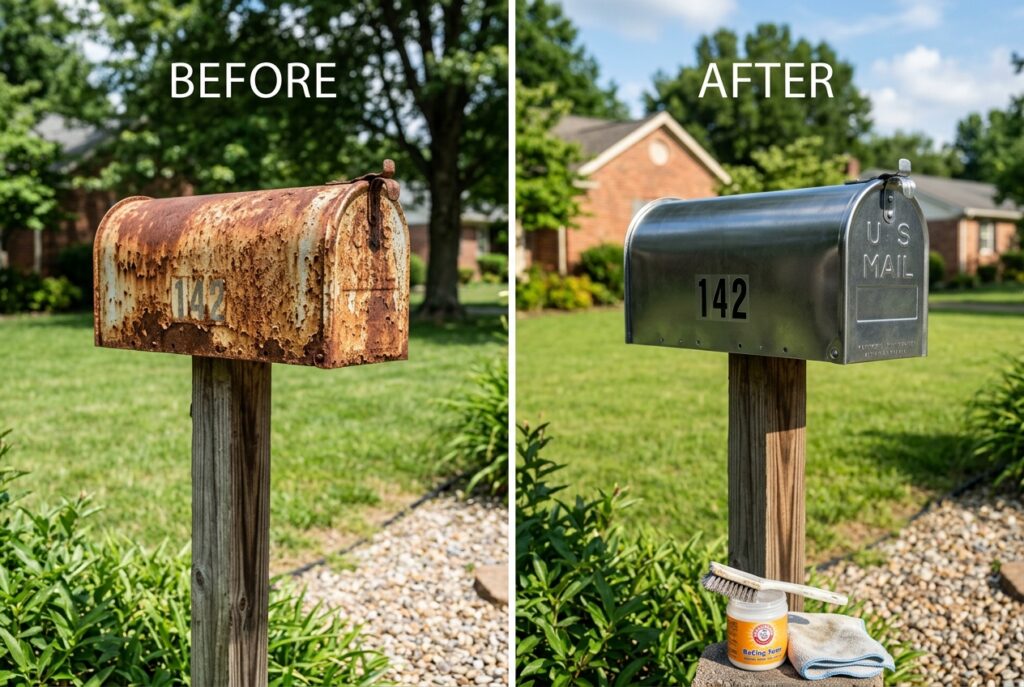
To remove rust from a metal mailbox: Mix 1/2 cup Baking Soda with 2 tbsp Dawn Dish Soap and 2-3 tbsp Hydrogen Peroxide (3%) into a thick paste. Apply the paste to all rusted areas and let it sit for 30 minutes. Spray with 1/2 cup White Vinegar to trigger a fizzing reaction that loosens rust particles from the metal. Scrub with a brass wire brush, rinse clean, dry completely, and seal with a rust-inhibiting primer or clear coat spray to prevent future corrosion.
Your curbside mailbox endures brutal punishment year-round. Scorching summer sun, winter ice storms, spring rain, road salt spray from passing snowplows, and constant humidity all conspire against the thin sheet metal. Over months and years, the factory paint coating chips, bubbles, and peels away, exposing raw steel or galvanized metal to oxygen and moisture. The result is unmistakable: ugly orange and brown rust spots that spread like a disease across the mailbox body, door, flag bracket, and mounting post.
A rusty mailbox is more than a cosmetic eyesore — it signals neglect to your mail carrier, your HOA, and your neighbors. Severe rust weakens the metal structure, causes the door hinge to seize, allows rainwater to soak your mail, and eventually eats completely through the steel panels. Replacing a quality curbside mailbox costs $40 to $150+, plus installation labor. But in most cases, even heavily rusted mailboxes can be fully restored to like-new condition in under an hour using inexpensive household ingredients.
This guide uses a powerful 3-ingredient combination of baking soda, Dawn dish soap, and white vinegar — with an optional hydrogen peroxide boost for deep, pitted rust — to chemically dissolve iron oxide (rust), mechanically scrub away corroded particles, and prepare the clean metal surface for a protective finish that prevents rust from ever returning.
- Understanding Why Mailboxes Rust
- 🧹 What You Need
- Step 1: Remove Loose Rust, Flaking Paint & Surface Debris
- Step 2: Mix the Rust-Dissolving Paste
- Step 3: Apply the Paste & Allow Deep Penetration
- Step 4: Spray with White Vinegar for Fizzing Reaction
- Step 5: Scrub Away Dissolved Rust
- Step 6: Rinse, Dry & Prepare for Sealing
- Step 7: Seal & Protect with Rust-Inhibiting Primer
- ⚠️ What Not to Do
- Long-Term Rust Prevention & Mailbox Care
- ❓ FAQ
- ✅ Bottom Line
- 📖 Related Cleaning Guides
- Author
Understanding Why Mailboxes Rust
Rust is iron oxide (Fe₂O₃), a chemical compound formed when iron atoms in steel react with oxygen and water molecules. This oxidation reaction is accelerated by:
- Road Salt & De-Icing Chemicals: Sodium chloride and calcium chloride spray from plowed roads acts as an electrolyte, dramatically speeding the electrochemical corrosion process on mailbox surfaces near the curb.
- Chipped Paint & Scratches: Even tiny scratches from lawn equipment or hail expose raw metal to moisture. Once rust starts beneath the paint, it spreads laterally under the coating, causing bubbling and flaking.
- Standing Water & Poor Drainage: Mailboxes with flat tops or poorly sealed seams collect pooling rainwater and morning dew, creating prolonged wet contact that feeds oxidation 24/7.
- Humidity & Coastal Salt Air: Properties near oceans, lakes, or rivers experience higher ambient humidity and airborne salt particles that accelerate corrosion on all exposed metals.
The good news: rust is a surface chemical reaction, not structural damage (unless it has eaten completely through the metal). By chemically converting or dissolving the iron oxide layer and sealing the clean steel underneath, you can stop corrosion dead in its tracks.
🧹 What You Need
- Baking Soda (Sodium Bicarbonate): 1/2 cup — mild abrasive that softens rust and creates alkaline cleaning paste.
- Dawn Ultra Dish Soap: 2 tablespoons — surfactant that cuts through oily grime and loosens flaking paint.
- White Vinegar (5% Acidity): 1/2 cup in a spray bottle — dissolves iron oxide through acid-base reaction.
- Hydrogen Peroxide (3%): 2 tablespoons (optional, for deep pitted rust) — accelerates oxidation breakdown.
- Warm Water: 2 to 3 tablespoons for paste + bucket for rinsing.
- Brass Wire Brush or Medium-Grit Steel Wool (#00 or #0): For scrubbing loosened rust.
- 120-Grit and 220-Grit Sandpaper: For smoothing heavily pitted areas before priming.
- Clean Microfiber Cloths / Paper Towels: For wiping and drying.
- Rust-Inhibiting Spray Primer (Rust-Oleum or Krylon): For sealing clean metal after rust removal.
- Exterior Spray Paint or Clear Coat (optional): For final color restoration and UV protection.
Step 1: Remove Loose Rust, Flaking Paint & Surface Debris
Before applying any chemical paste, you need to knock off the loose, flaking rust scales and peeling paint chips that sit on top of the active corrosion layer. Take a brass wire brush or stiff-bristle scrub brush and vigorously brush the entire exterior of the mailbox — the body panels, door face, door edges, hinge area, flag bracket, and the top seam where water pools.
For large sections of bubbling, peeling paint, use a plastic scraper or putty knife to pop off the loose paint flakes. Don’t worry about removing firmly adhered paint — only remove material that is actively flaking. Brush away all loose debris with a dry cloth. This step exposes the active rust underneath so the cleaning paste can make direct contact with the corroded metal.
Step 2: Mix the Rust-Dissolving Paste
In a small mixing bowl, combine:
- 1/2 cup baking soda
- 2 tablespoons Dawn dish soap
- 2 to 3 tablespoons warm water (use hydrogen peroxide instead of water for severe rust)
Stir until a thick, smooth paste forms with the consistency of peanut butter. For mailboxes with deep, pitted rust holes or extensive corrosion, replace the warm water entirely with 2 to 3 tablespoons of 3% hydrogen peroxide. The peroxide acts as a mild oxidizer that helps chemically break down deeply embedded iron oxide crystals that baking soda alone cannot reach.
The science behind this combination:
- Baking soda (pH 8.3): Creates an alkaline environment that softens rust bonds and provides gentle abrasive scrubbing particles.
- Dawn surfactants: Penetrate under loosened rust flakes and dissolve oily road grime that protects the rust layer.
- Hydrogen peroxide: Releases active oxygen that oxidizes and converts stable Fe₂O₃ rust into softer, water-soluble iron compounds that rinse away easily.
Step 3: Apply the Paste & Allow Deep Penetration
Using a disposable brush, old toothbrush, or gloved hands, spread the paste generously over every rusty area of the mailbox. Work the paste into pitted spots, along seam edges, inside the door hinge cavity, around rivet heads, and onto the flag bracket mechanism.
For light surface rust (orange discoloration on intact metal), let the paste dwell for 15 to 20 minutes.
For heavy, deep rust with visible pitting and texture, wrap the treated areas with plastic cling wrap to lock in moisture and prevent the paste from drying out. Let this covered paste sit for 30 to 45 minutes. The longer dwell time allows the chemical agents to penetrate deeper into the porous rust layer.
Step 4: Spray with White Vinegar for Fizzing Reaction
Remove any plastic wrap and fill a clean spray bottle with 1/2 cup of distilled white vinegar. Hold the spray bottle 4 to 6 inches from the mailbox surface and spray the vinegar directly over the baking soda paste layer.
The acetic acid (CH₃COOH) in the vinegar reacts instantly with the sodium bicarbonate (NaHCO₃) in the baking soda, producing a vigorous fizzing eruption of carbon dioxide gas. This carbonation reaction serves two critical purposes:
- Mechanical Lifting: Millions of expanding CO₂ micro-bubbles physically push loosened rust particles away from the metal surface.
- Acid Dissolution: The acetic acid directly dissolves iron oxide, converting it into water-soluble iron acetate that washes away cleanly.
Spray generously — the entire mailbox should be foaming and fizzing. Let the reaction work for 3 to 5 minutes.
Step 5: Scrub Away Dissolved Rust
Take your brass wire brush or #00 steel wool and scrub the foaming surface in firm, overlapping strokes. The dissolved rust will transform into a dark brownish-orange liquid slurry. For heavily pitted areas, use 120-grit sandpaper wrapped around a sanding block to smooth the rough metal surface.
Pay close attention to:
- The bottom edge of the mailbox body (where water drips and pools)
- The door hinge pin area (moisture trap)
- The top seam and corners (where paint chips first)
- The flag bracket mounting screws (salt accumulation zone)
For stubborn rust patches that resist the first treatment, apply a second round: fresh baking soda paste directly onto the stubborn spot, let it sit for 10 minutes, spray with vinegar again, and scrub. Most rust will surrender after two treatments.
Step 6: Rinse, Dry & Prepare for Sealing
Rinse the entire mailbox thoroughly with clean water from a garden hose or bucket. Remove all traces of baking soda, vinegar, and rust residue. Inspect the metal carefully — clean steel should appear as a smooth, silvery-grey surface where rust has been removed.
Dry the mailbox completely with clean microfiber towels. For fastest results, leave the mailbox in direct sunlight for 20 to 30 minutes to evaporate every micro-droplet of moisture from seams and pitted areas. Do not leave bare metal exposed overnight without protection — fresh surface rust (flash rust) can begin forming within 2 to 4 hours on clean steel in humid conditions.
Step 7: Seal & Protect with Rust-Inhibiting Primer
Once the metal is completely dry, shake a can of rust-inhibiting spray primer (Rust-Oleum Stops Rust Primer or Krylon Rust Protector) for 2 minutes. Apply 2 to 3 thin, even coats to all bare metal areas, holding the can 10 to 12 inches away and using smooth, sweeping passes. Allow 15 minutes between coats.
For a full cosmetic restoration, follow the primer with 2 coats of exterior-grade spray paint in your desired color (black, white, bronze, or dark green are popular mailbox colors). Alternatively, apply a clear coat UV-resistant spray if you prefer the natural metal look.
⚠️ What Not to Do
- Never use naval jelly or phosphoric acid on galvanized mailboxes: These harsh acid-based rust removers strip the protective zinc coating from galvanized steel, causing accelerated corrosion worse than the original rust.
- Never sand aluminum mailboxes with steel wool: Steel particles left behind on aluminum create galvanic corrosion cells that cause rapid pitting.
- Never leave bare metal exposed to rain: Always apply primer or oil within 2 to 4 hours of rust removal to prevent flash rust from forming on freshly cleaned steel.
- Never spray paint over active rust: Paint will not adhere to rust — it will bubble and peel within weeks. Always remove all rust and prime bare metal first.
Long-Term Rust Prevention & Mailbox Care
- Annual Wax Coat: Apply a thin layer of automotive paste wax (like Turtle Wax) to the mailbox exterior once per year in spring. The wax barrier repels moisture and road salt.
- Touch-Up Paint: Keep a small can of matching spray paint on hand. When you notice any new paint chip or scratch, spray it immediately before rust has a chance to start.
- Clear Silicone Caulk on Seams: Apply a thin bead of clear silicone caulk along the top seam and door edges to prevent water from pooling in the joints where rust starts first.
- Post & Bracket Check: Inspect the mounting post and bracket hardware every 6 months for rust or looseness, especially after winter salt season.
❓ FAQ
Does vinegar actually dissolve rust?
Yes. White vinegar contains 5% acetic acid, which reacts with iron oxide (rust) to form water-soluble iron acetate. For light surface rust, a 30-minute vinegar soak can dissolve orange discoloration completely. For heavy, pitted rust, the baking soda paste + vinegar fizzing combination provides both chemical dissolution and mechanical lifting power.
When should I use hydrogen peroxide instead of water in the paste?
Use hydrogen peroxide (3%) as a substitute for the warm water in your baking soda paste when the rust is deep, pitted, and textured — meaning the metal surface feels rough and cratered to the touch. The active oxygen in peroxide penetrates deeper into pitted corrosion than water alone, breaking down embedded rust crystals that surface-level treatments cannot reach.
Can I use this method on an aluminum mailbox?
Aluminum does not rust (iron oxide), but it does form a white powdery corrosion called aluminum oxide. This baking soda and Dawn paste works well on aluminum corrosion. However, do NOT use steel wool on aluminum — use a nylon scrub pad or brass brush instead to avoid galvanic corrosion contamination.
How long will the mailbox stay rust-free after treatment?
With proper sealing (2 coats of rust-inhibiting primer + 2 coats of exterior paint + annual wax touch-up), a treated mailbox can remain rust-free for 5 to 10+ years, even in harsh winter climates with heavy road salt exposure.
Is it worth restoring a rusty mailbox or should I just buy a new one?
If the rust has eaten completely through the metal panels (you can see daylight through holes), replacement is the better option. But if the metal is still structurally intact with only surface and moderate pitting rust, restoration takes about 45 minutes and costs under $10 in supplies versus $50 to $150+ for a new mailbox plus installation.
✅ Bottom Line
Removing rust from a metal mailbox doesn’t require expensive commercial rust removers or dangerous acid chemicals. The 3-ingredient combination of baking soda, Dawn dish soap, and white vinegar — with an optional hydrogen peroxide boost for deep pitting — safely dissolves iron oxide, lifts corrosion from the metal surface, and prepares clean steel for a protective primer and paint seal that keeps your mailbox looking sharp for years. The entire restoration takes under an hour and costs less than $10 in supplies you already have at home.