You flip the wall switch after washing dinner dishes, and instead of the familiar throaty roar of grinding food scraps, your kitchen sink emits a low, ominous electric hum: “Bzzzzzz…” Within 10 to 15 seconds, a faint click sounds, and the unit goes dead silent. The panic is immediate: has the motor burned out? Do you need to replace the entire under-sink appliance?
Here is the contractor secret that every home warranty technician knows: in over 95% of cases where a garbage disposal is humming or unresponsive, the motor is completely undamaged. The rotating stainless steel flywheel shredder plate has merely wedged against a stationary grind ring tooth due to a foreign obstruction (a peach pit, chicken bone fragment, or stringy fibrous celery). The internal thermal overload protector tripped to save the copper windings from melting. In this 3-minute emergency repair protocol, we teach you how to unjam the flywheel using an under-sink manual wrench socket and reset the safety breakeru2014saving you an instant $250 plumber visit.
ud83dudcb0 Contractor Price Reality Check: Jammed Garbage Disposal
| Service Item | Standard Plumbing Invoice | DIY TidyUp Daily Method | Your Net Savings |
|---|---|---|---|
| Standard Diagnostic / Dispatch Fee | $125 – $180 | $0.00 (Self-Diagnostic) | Save $150 |
| Manual Flywheel Dislodgement Labor | $95 – $140 | $0.00 (1/4″ Hex Wrench) | Save $115 |
| Unnecessary Disposal Replacement (Up-sell) | $350 – $550 | $0.00 (Existing Motor Preserved) | Save $400 |
| Total Typical Cost | $220 – $320 | $0.00 | Save $250+ (100% Free) |
The Anatomy of a Jammed Disposal: What the Hum Means
To understand the fix, you need to understand how a continuous-feed food waste disposer works. Inside the grind chamber sits a heavy circular plate called the flywheel. Attached to this flywheel are two swinging stainless steel impellers (lugs). When the motor turns at 1,725 to 2,800 RPM, centrifugal force flings food scraps against a stationary 360-degree shredder ring with perforated micro-teeth, pulverizing food into small liquid-borne particulates.
Unlike blenders, garbage disposals do not have spinning blades. When an object with high compressive strength (such as an unpopped popcorn kernel, cherry pit, or small metal coin) wedges into the microscopic gap between the edge of the flywheel and the stationary shredder wall, the motor instantly stalls. Because 120-volt alternating current is still flowing into the copper motor coils, the stalled electromagnetic field vibrates at 60 Hzu2014producing the distinct low humming sound.
Required Tools & Cleaning Supplies
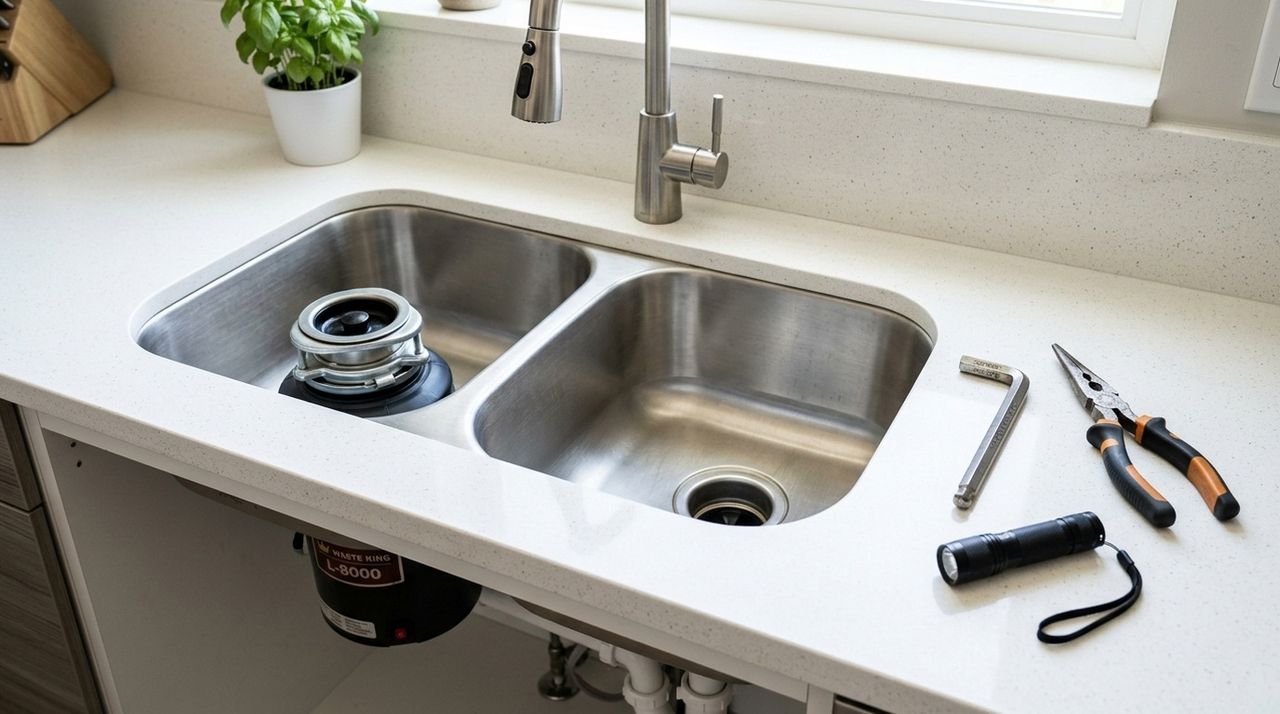
- 1/4-Inch Hex Key (Allen Wrench) or Jam-Buster Wrench
- High-Lumen Flashlight or Smartphone Torch
- Long Needle-Nose Pliers or Kitchen BBQ Tongs
- Heavy Duty Rubber Gloves
- 2 Cups Fresh Ice Cubes
- 1/2 Cup Coarse Kosher or Rock Salt
Save $4,000+ in Unnecessary Contractor & Emergency Service Calls
Don’t let contractors charge you $500 for a 15-minute diagnostic. Master verified step-by-step repair decision trees, non-toxic formulations, and seasonal appliance protection in the complete field manual by Yolo Fisher.
The 3-Minute Hex Key & Reset Execution Protocol
Immediate Switch Shut-Off & Safety Check
The second you hear the disposal humming without spinning, immediately toggle the wall switch to OFF. A locked rotor draws locked-rotor amperage (LRA)u2014nearly 6 times its normal operating current. Leaving the switch on will burn out the stator motor coils within 60 seconds if the thermal breaker fails. For complete peace of mind, reach under the sink cabinet and unplug the unit from the 120V wall receptacle.
Manual Bottom Hex Socket Flywheel Rotation
Look at the bottom of the disposal housing under your sink. In the exact dead center of the bottom plate, manufacturers (such as InSinkErator, Moen, Waste King) engineer a 1/4-inch hex socket directly connected to the central motor shaft. Insert a standard 1/4-inch Allen wrench (or the silver offset wrench that came taped to the disposal manual). Push the wrench firmly back and forth. You will feel heavy resistance where the foreign object is wedged. Apply firm, steady torque clockwise and counter-clockwise until the jam pops free and the wrench completes a full, effortless 360-degree rotation.
Chamber Foreign Object Extraction
Now that the flywheel is moving freely, the wedged debris is loose inside the chamber. NEVER put your fingers or hand down inside the disposal throat, even with the power unplugged. Shine a flashlight down past the rubber splash guard flaps. Using long needle-nose pliers or metal kitchen tongs, grasp and pull out the culprit object. Common obstructions include fruit pits, avocado seeds, small bones, broken glass shards, bottle caps, or twisted twist-ties.
Thermal Overload Reset Button Depression
If the unit hummed initially and then clicked dead, its built-in bimetallic thermal breaker popped out to protect against over-current fire. Look at the lower side or bottom edge of the disposal housing for a small red button. If it has popped out approximately 1/4 inch, press it firmly inward with your thumb until you feel a distinct mechanical click. If the disposal was humming for several minutes prior, wait 5 minutes for the internal thermal sensor to cool down before resetting.
Cold Water High-Torque Test Run & Ice Clean
Plug the power cord back into the wall outlet. Turn your cold water faucet on full blast. Flip the wall switch ON. The disposal should roar to life with smooth, high-velocity balance. While running, dump 2 full cups of ice cubes and 1/2 cup of coarse kosher salt down the drain. As the centrifugal impellers pulverize the rock-hard ice and salt, the abrasive slurry scours gelatinous grease, food slime, and microscopic burrs off the shredder ring, restoring like-new grinding efficiency.
u26a0ufe0f The 5 Worst Things for a Kitchen Disposal
To prevent future emergency jams and pipe clogging, never feed these five materials into any residential disposer:
- Fibrous Celery & Corn Husks: Long stringy cellulose fibers wrap around the center shaft like fishing line, jamming bearings.
- Potato Peels: High starch content turns into thick mashed paste that instantly chokes 1.5-inch sink trap pipes.
- Coffee Grounds: Dense micro-granules do not degrade; they settle into p-trap low points like heavy river silt.
- Animal Grease & Bacon Fat: Solidifies downstream upon meeting cold pipe walls, creating obstructive fatbergs.
- Eggshells: The thin internal membrane peels off and adheres to the shredder ring teeth, catching debris.
Frequently Asked Questions: Garbage Disposal Unjamming
Why does my garbage disposal hum but not spin when turned on?
A humming sound indicates the 120V electric motor is receiving current, but the rotating flywheel shredder plate is physically jammed against the stationary grind ring by foreign debris, preventing rotation.
Where is the reset button on a garbage disposal?
The red thermal overload reset button is located on the underside or lower rear side of the disposal motor housing. It automatically trips and pops out to prevent motor burn-out when jammed.
Can I use boiling hot water to unjam a garbage disposal?
Never use boiling water during unjamming. Boiling water melts fats and animal grease into liquid that coats the impellers and coats the drain pipes further down. Always run cold water, which keeps fats solidified so shredder cutters can pulverize them.