Quick Answer
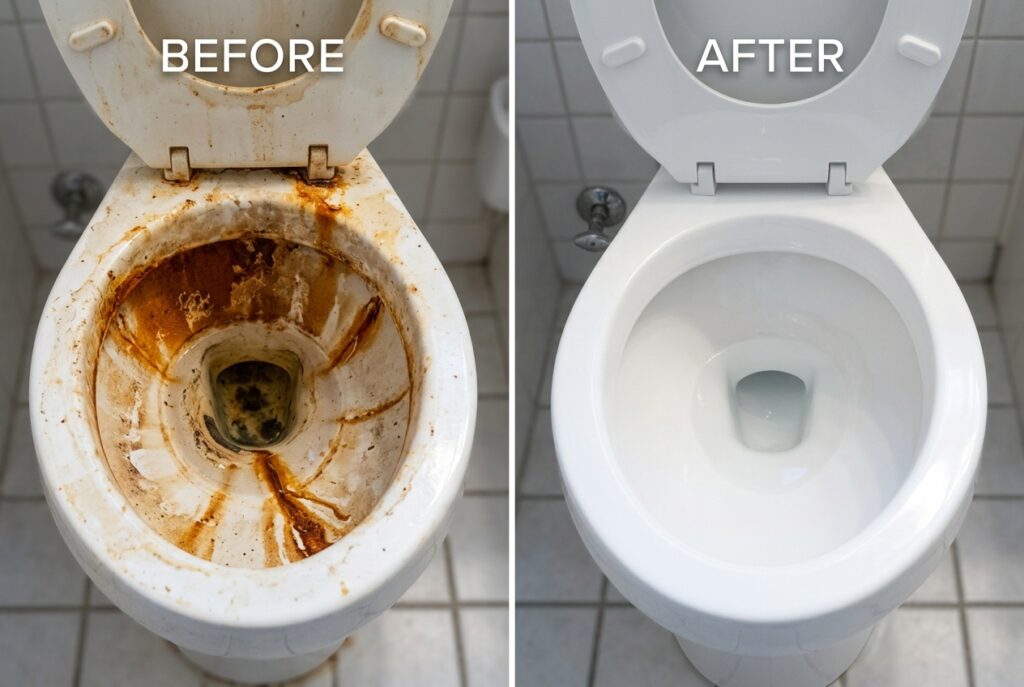
To clean a stained and rusty toilet bowl: Flush to wet the bowl, then sprinkle 1 cup Baking Soda directly onto rust stains and under the rim. Squirt 2 tbsp Dawn Dish Soap over the baking soda. Pour 1 cup White Vinegar into the bowl to trigger a fizzing reaction that dissolves iron oxide rust and mineral deposits. Let it foam and dwell for 20 to 30 minutes, scrub with a stiff toilet brush, and flush. For severe rust rings, make a thick paste with baking soda and a few drops of hydrogen peroxide (3%), apply directly to the stain, wait 15 minutes, then scrub and flush.
Few things are more embarrassing than a toilet bowl streaked with ugly orange rust stains, brown hard water rings, and yellowish mineral discoloration. These stains accumulate gradually from iron-rich well water, corroding internal tank components, aging municipal pipes, and high-mineral hard water that deposits calcium, lime, and magnesium carbonate with every flush. Over months, the deposits bond chemically to the porous glaze of the porcelain, making them virtually immune to regular toilet bowl cleaners and casual scrubbing.
Most commercial toilet bowl cleaners rely on hydrochloric acid (HCl) or sodium hypochlorite (bleach) as their active ingredient. While these chemicals can lighten surface discoloration temporarily, they come with serious drawbacks: hydrochloric acid produces toxic fumes in enclosed bathrooms, bleach can actually set certain rust stains permanently by oxidizing the iron deeper into the porcelain glaze, and both chemicals damage septic systems and corrode internal toilet hardware over time.
The natural alternative is far more effective against rust and mineral deposits: a strategic combination of baking soda, Dawn dish soap, and white vinegar — with an optional hydrogen peroxide boost for severe rust pitting. This trio attacks stains through three distinct chemical mechanisms simultaneously, dissolving mineral bonds, emulsifying organic grime, and physically lifting rust particles from porcelain without damaging the glaze or your plumbing.
- Understanding Toilet Bowl Stain Chemistry
- 🧹 What You Need
- Step 1: Lower the Water Level
- Step 2: Apply Baking Soda & Dawn Paste
- Step 3: Pour Vinegar for Fizzing Dissolution
- Step 4: Let It Dwell (This Is the Critical Step)
- Step 5: Scrub Thoroughly & Flush
- Step 6: Clean the Exterior & Tank Hardware
- ⚠️ What Not to Do
- Long-Term Prevention & Maintenance
- ❓ FAQ
- ✅ Bottom Line
- 📖 Related Cleaning Guides
- Author
Understanding Toilet Bowl Stain Chemistry
Before scrubbing blindly, it helps to understand what type of stain you are dealing with, because different stains respond to different chemical approaches:
- Orange / Red-Brown Rust Stains: Caused by dissolved iron (Fe²⁺) in well water or corroding iron pipes and tank bolts. When iron-rich water sits in the bowl, oxygen converts dissolved ferrous iron into solid ferric oxide (Fe₂O₃) — visible rust. These stains respond best to acid dissolution (vinegar) combined with mild abrasion (baking soda).
- White / Grey Hard Water Rings: Caused by calcium carbonate (CaCO₃) and magnesium deposits from hard municipal water. These mineral scale rings form at the waterline and under the rim. They dissolve readily in acidic solutions — vinegar’s acetic acid reacts with calcium carbonate to produce water-soluble calcium acetate.
- Yellow / Brown Organic Stains: Caused by tannins in well water, uric acid salt buildup, or biofilm (bacteria colonies). Dawn dish soap’s surfactants emulsify these organic compounds, while baking soda’s alkalinity neutralizes uric acid salts.
- Black Rings Under the Rim: Caused by mold, mildew, and mineral-feeding bacteria growing in the dark, constantly moist environment under the toilet rim jets. These respond to the oxidizing action of hydrogen peroxide and the scrubbing power of baking soda paste.
Our 3-ingredient method addresses all four stain types in a single treatment cycle.
🧹 What You Need
- Baking Soda (Sodium Bicarbonate): 1 cup — mild abrasive and alkaline stain softener.
- Dawn Ultra Dish Soap: 2 tablespoons — surfactant that cuts through organic grime, biofilm, and uric acid buildup.
- White Vinegar (5% Acidity): 1 cup — dissolves rust (iron oxide), calcium carbonate, and lime scale through acid reaction.
- Hydrogen Peroxide (3%): 1/4 cup (optional, for severe rust or black mold rings) — oxidizer that breaks down deep stains and kills bacteria.
- Stiff-Bristle Toilet Bowl Brush: For scrubbing the bowl interior and under-rim jets.
- Old Toothbrush or Detail Brush: For scrubbing under the rim and around the bolt holes.
- Rubber Gloves: For hand protection during scrubbing.
- Spray Bottle: For applying vinegar precisely under the rim.
- Pumice Stone (optional): For extreme hard water ring buildup on porcelain only — never use on colored or plastic toilets.
Step 1: Lower the Water Level
For the cleaning agents to work at full concentration directly on the stains, you need to reduce the standing water level in the bowl. Turn off the water supply valve behind the toilet (turn clockwise until snug). Flush the toilet once — this drains most of the water from the bowl, exposing the rust-stained porcelain and the hard water ring at the former waterline.
If you cannot access the shutoff valve, simply push a toilet plunger down firmly 4 to 5 times to force water down the drain, lowering the bowl level significantly. The goal is to expose as much stained porcelain surface as possible so the paste and vinegar can make direct chemical contact with the deposits.
Step 2: Apply Baking Soda & Dawn Paste
Sprinkle 1 full cup of baking soda directly into the toilet bowl, concentrating the powder on visible rust stains, the hard water ring line, and under the rim where black mold tends to hide. The baking soda should coat the porcelain like a white dusting of snow.
Squirt 2 tablespoons of Dawn dish soap over the baking soda layer. The soap serves two critical functions: its surfactant molecules penetrate under the loosened stain particles to prevent them from re-adhering to the porcelain during scrubbing, and its degreasing agents dissolve organic biofilm and uric acid salt deposits that trap and anchor mineral stains to the bowl surface.
For the under-rim area, use an old toothbrush or detail brush to work the baking soda and Dawn mixture directly into each rim jet hole. These small openings are breeding grounds for black mold and mineral scale that cause dark streaks running down the bowl interior.
Step 3: Pour Vinegar for Fizzing Dissolution
Slowly pour 1 cup of white vinegar directly over the baking soda-coated stains. The acetic acid reacts immediately with the sodium bicarbonate, producing an aggressive fizzing eruption of carbon dioxide gas bubbles throughout the bowl.
This carbonation reaction does three things simultaneously:
- Dissolves Iron Oxide (Rust): Acetic acid converts insoluble iron oxide (Fe₂O₃) into water-soluble iron acetate, which rinses away with flushing.
- Breaks Down Calcium Carbonate (Hard Water Scale): The acid reacts with CaCO₃ to produce calcium acetate, water, and CO₂ gas — effectively dissolving the mineral ring.
- Mechanical Lifting: Millions of expanding CO₂ micro-bubbles physically push loosened stain particles away from the porcelain glaze.
For the under-rim area, fill a spray bottle with vinegar and spray directly up into each rim jet. You will hear fizzing inside the rim channel as the vinegar contacts the baking soda packed into the jets.
Step 4: Let It Dwell (This Is the Critical Step)
Do not scrub immediately. The chemical dwell time is the most important factor in stain removal — far more important than scrubbing force. Let the fizzing baking soda, Dawn, and vinegar mixture sit undisturbed in the bowl for 20 to 30 minutes.
During this dwell period, the acid continues penetrating deeper into porous mineral deposits and rust layers, while the soap surfactants undercut the stain bond to the porcelain. For toilets with years of neglected buildup, extend the dwell time to 45 minutes to 1 hour for maximum penetration.
For severe rust pitting: While the vinegar mixture is dwelling in the lower bowl, make a separate thick paste by mixing 3 tablespoons of baking soda with 2 tablespoons of hydrogen peroxide (3%). Apply this paste directly onto the worst rust-stained areas above the waterline. The peroxide releases active oxygen that oxidizes and loosens deeply embedded iron oxide crystals that vinegar alone cannot reach. Let this paste sit for an additional 15 minutes.
Step 5: Scrub Thoroughly & Flush
After the dwell period, take your stiff-bristle toilet brush and scrub the entire bowl interior vigorously. Start under the rim, pushing the brush bristles into each rim jet hole to dislodge loosened scale and mold. Work your way down the bowl walls in firm circular motions, paying extra attention to the waterline ring and any remaining rust patches.
For stubborn hard water rings that resist the brush, wet a pumice stone and gently rub the mineral deposit in a circular motion. Pumice is softer than porcelain glaze and will not scratch a standard ceramic toilet — but never use pumice on colored, coated, or plastic toilet surfaces.
Turn the water supply valve back on (counter-clockwise), let the tank refill, and flush. Inspect the bowl — most stains will be completely gone after one treatment. For extremely neglected toilets with years of iron buildup, repeat Steps 2 through 5 a second time for a pristine finish.
Step 6: Clean the Exterior & Tank Hardware
While you have the cleaning supplies out, wipe down the toilet exterior — the base, hinges, seat bolts, and tank handle — with a microfiber cloth dampened with a 50/50 vinegar and water solution. These areas collect dust, splash residue, and bathroom humidity grime that yellows over time.
If you notice rust on the tank bolts, flush handle, or internal flapper chain, these corroding metal parts are likely the source of your bowl rust stains. Consider replacing rusted tank bolts and the flush valve with brass or stainless steel hardware to permanently eliminate the iron source contaminating your bowl water.
⚠️ What Not to Do
- Never mix bleach with vinegar: Combining bleach (sodium hypochlorite) with vinegar (acetic acid) produces toxic chlorine gas, which causes severe respiratory damage and can be lethal in enclosed bathrooms.
- Never use bleach on rust stains: Bleach oxidizes iron further, driving the rust deeper into porcelain pores and making the stain darker and more permanent.
- Never use abrasive scouring powders on colored toilets: Comet, Ajax, and similar chlorinated abrasive cleaners scratch the decorative glaze on colored porcelain, creating micro-grooves where future stains embed permanently.
- Never pour boiling water into a cold toilet bowl: Thermal shock can crack the porcelain, especially on older toilets with existing hairline stress fractures.
- Never use metal brushes or steel wool inside the bowl: Metal fragments scratch porcelain and leave behind iron particles that cause new rust stains within days.
Long-Term Prevention & Maintenance
- Weekly Baking Soda Sprinkle: Once a week, sprinkle 1/2 cup of baking soda into the bowl before bed. Let it sit overnight, brush lightly in the morning, and flush. This prevents mineral scale from ever building up.
- Monthly Vinegar Tank Treatment: Pour 2 cups of white vinegar into the toilet tank (not the bowl) once a month. Let it sit for 30 minutes, then flush twice. This dissolves mineral deposits inside the tank and prevents rust from internal hardware from staining the bowl.
- Install a Whole-House Water Softener or Iron Filter: If you have well water with high iron content, a dedicated iron filter or water softener at the main supply line eliminates the root cause of recurring rust stains throughout your home.
- Replace Rusted Tank Hardware: Swap corroding iron tank bolts, flapper chains, and fill valves with brass or plastic alternatives to stop internal rust from reaching the bowl.
❓ FAQ
Does vinegar actually remove rust from a toilet bowl?
Yes. White vinegar contains 5% acetic acid, which chemically converts insoluble iron oxide (rust) into water-soluble iron acetate that flushes away cleanly. For light surface rust, a 20-minute vinegar soak dissolves the orange discoloration completely. For deep, pitted rust, combining vinegar with baking soda paste and hydrogen peroxide provides the strongest natural treatment available.
Why does my toilet keep getting rust stains even after cleaning?
Recurring rust stains almost always indicate an iron source in your water supply. Common causes include: corroding iron pipes in older homes, rusting internal tank hardware (bolts, chains, fill valves), or high dissolved iron in well water. Cleaning removes existing stains, but you must address the iron source — replace rusted tank parts or install a whole-house iron filter — to stop stains from returning.
Can I use Coca-Cola instead of vinegar to clean a toilet?
Coca-Cola contains phosphoric acid (H₃PO₄), which does dissolve light mineral deposits and rust. However, Coke also contains caramel color, sugar, and syrup that leave a sticky residue and can feed bathroom bacteria. White vinegar is far more effective, cheaper, leaves no residue, and is food-safe for your plumbing and septic system.
Is it safe to use a pumice stone on a toilet bowl?
Yes, on standard white porcelain toilets. Natural pumice stone (volcanic glass) has a Mohs hardness of approximately 6, while porcelain glaze rates 7 to 8. This means pumice will abrade mineral deposits without scratching the harder glaze surface. Always wet the pumice stone before use to lubricate the contact. Never use pumice on colored porcelain, plastic, or composite toilets.
How do I clean black mold under the toilet rim?
Pack a thick paste of baking soda and hydrogen peroxide (3:1 ratio) directly into each rim jet hole using an old toothbrush. Spray with vinegar and let the fizzing paste sit for 20 minutes. Scrub each jet with the toothbrush bristles and flush. Repeat monthly to prevent mold regrowth in the dark, moist rim channel.
✅ Bottom Line
Cleaning a stained, rusty toilet bowl doesn’t require dangerous hydrochloric acid cleaners or expensive commercial products. The combination of baking soda (mild abrasive + alkaline softener), Dawn dish soap (surfactant + organic grime cutter), and white vinegar (acid rust dissolver + mineral scale breaker) — with an optional hydrogen peroxide boost for severe pitting — safely removes every type of toilet bowl stain: orange rust, brown hard water rings, yellow uric acid deposits, and black under-rim mold. The entire deep clean takes about 30 minutes of hands-on work and costs less than $2 in household ingredients.