Quick Answer
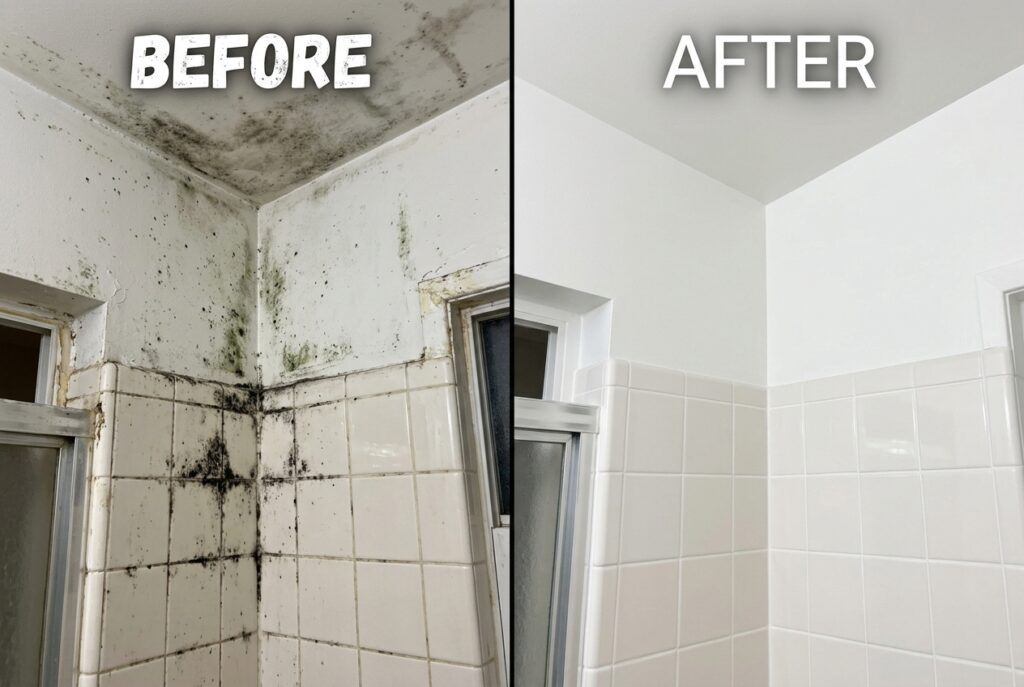
A paste of baking soda and hydrogen peroxide, combined with a flat beer spray, kills mold on bathroom surfaces within 1 to 2 hours. The peroxide oxidizes the mold’s cell walls, baking soda scrubs and deodorizes, and the hops in beer contain natural antimicrobial compounds called lupulones that inhibit mold regrowth.
Most people reach for bleach when they see mold. But bleach has a major limitation that most cleaning guides never mention — it only kills surface mold. On porous surfaces like grout, drywall, and caulk, the water in bleach actually feeds the mold roots underneath while only whitening the surface. The mold comes back within days.
The combination of hydrogen peroxide, baking soda, and beer attacks mold through three separate mechanisms: oxidation, alkaline disruption, and antimicrobial inhibition. Each ingredient targets a different part of the mold’s biology, which is why this method outperforms any single product.
💡 The Science: Mold is a multicellular fungus that reproduces through airborne spores. The visible black or green patches are colonies of hyphae — thread-like filaments that penetrate into porous materials. Killing the surface without killing the hyphae is why mold keeps coming back. Hydrogen peroxide (H₂O₂) is an oxidizing agent — it releases oxygen free radicals that destroy organic cell walls at the molecular level, reaching deeper than bleach.
- 🧹 What You Need
- Step 1: Spray Flat Beer on the Moldy Area
- Step 2: Apply the Baking Soda and Peroxide Paste
- Step 3: Let It Dwell for 1 to 2 Hours
- Step 4: Scrub and Rinse
- Step 5: Final Beer Spray for Prevention
- ⚠️ What Not to Do
- How to Prevent Mold from Returning
- ❓ FAQ
- ✅ Bottom Line
- 📖 Related Cleaning Guides
- Author
🧹 What You Need
- 🔹 3% hydrogen peroxide — the standard brown-bottle pharmacy kind. This is an oxidizing biocide that destroys mold cell walls through free radical release. Do not use higher concentrations without gloves.
- 🔹 Baking soda (sodium bicarbonate) — mild alkali (pH 8.3) that disrupts mold’s preferred acidic environment. Also works as a gentle abrasive for scrubbing and absorbs musty odors.
- 🔹 Flat beer (any cheap lager, left open overnight) — hops contain lupulones and humulones, bitter acids with proven antifungal properties. A 2015 study in the Journal of the Institute of Brewing confirmed that hop compounds inhibit fungal growth at concentrations as low as 50 ppm.
- 🔹 Spray bottle — for the beer and peroxide solutions
- 🔹 Old toothbrush or grout brush — for scrubbing into textured surfaces. We recommend the Rugged Grout Brush for heavy mold on tile lines.
- 🔹 Microfiber cloth — for wiping and drying after treatment
Step 1: Spray Flat Beer on the Moldy Area
Pour flat beer (opened and left out for at least 8 hours so the carbonation escapes) into a spray bottle. Spray the moldy surface generously until it is wet. Let it sit for 10 minutes.
💡 The Science: Hops — the plant Humulus lupulus used to bitter beer — produce compounds called alpha-acids (humulones) and beta-acids (lupulones). These compounds disrupt the cell membranes of fungi and bacteria by increasing membrane permeability. In simple terms, they poke holes in the mold’s protective outer layer. Carbonation would evaporate the solution too fast, which is why flat beer works better — it stays on the surface longer.
❌ Common Mistake: Do not use craft IPAs or hop-heavy beers — they leave sticky sugar residue that can actually feed new mold growth. Use the cheapest lager you can find. The hop content is sufficient in any commercial beer.
Step 2: Apply the Baking Soda and Peroxide Paste
In a small bowl, mix 3 tablespoons of baking soda with 2 tablespoons of hydrogen peroxide (3%) to form a thick paste. Spread this paste directly onto the moldy areas using your fingers (wear gloves) or an old toothbrush. Press it into grout lines, caulk seams, and textured surfaces where mold hides in crevices.
💡 The Science: When baking soda (NaHCO₃) meets hydrogen peroxide (H₂O₂), two things happen. First, the alkaline baking soda raises the local pH above 8 — mold thrives in acidic to neutral environments (pH 3-7) and cannot survive sustained alkaline conditions. Second, hydrogen peroxide decomposes into water and oxygen free radicals (O⁻) that oxidize the ergosterol in mold cell membranes, causing the cells to rupture and die. The paste format ensures sustained contact on vertical surfaces instead of running off like a liquid spray would.
Step 3: Let It Dwell for 1 to 2 Hours
Leave the paste on the surface for a minimum of 1 hour. For severe mold, leave it for 2 hours or overnight. Cover with plastic wrap if the paste is on a vertical surface and tends to dry out — the moisture is necessary for the peroxide to remain active.
💡 Pro Tip: If you are treating ceiling mold, apply the paste to strips of paper towel and press them against the ceiling. The paper towel holds the paste in place. Remove after 2 hours.
Step 4: Scrub and Rinse
After the dwell time, scrub the treated areas with a stiff-bristle brush or old toothbrush. For tile grout lines, a dedicated grout brush makes a significant difference — the angled bristles reach into the recessed grout joints where mold roots hide.
Rinse with warm water and wipe dry with a microfiber cloth. Inspect the surface — if black staining remains after two treatments, the mold has penetrated into the material itself and the caulk or grout should be replaced entirely.
Step 5: Final Beer Spray for Prevention
After cleaning, spray the area one more time with flat beer and let it air dry without rinsing. The residual hop compounds create an antimicrobial film on the surface that inhibits mold spore germination for several weeks. Reapply every 2 to 3 weeks as a preventative spray in high-humidity areas.
⚠️ What Not to Do
- ❌ Never mix hydrogen peroxide with vinegar. The combination creates peracetic acid, which is corrosive to skin, eyes, and lungs at household mixing ratios.
- Do not mix hydrogen peroxide with bleach — produces toxic oxygen gas and chlorine compounds
- Do not use beer that still has carbonation — the fizzing prevents the solution from adhering to surfaces
- Do not dry-brush mold before wetting it — this launches thousands of spores into the air you breathe
- Do not skip ventilation — open a window or run the exhaust fan during and after treatment
- Do not paint over mold — it will grow through the paint within weeks
How to Prevent Mold from Returning
- Run your bathroom exhaust fan for 30 minutes after every shower — this is the single most effective mold prevention step
- Keep indoor humidity below 60% — use a hygrometer to monitor and a dehumidifier if needed
- Squeegee shower walls and glass after each use to remove the moisture film mold feeds on
- Spray high-risk areas with flat beer or hydrogen peroxide once every 2 to 3 weeks as a preventative
- Fix any leaky pipes, dripping faucets, or poor caulking immediately — moisture is the root cause
- Replace silicone caulk every 3 to 5 years or at the first sign of cracking
❓ FAQ
Does beer actually kill mold?
Beer alone is a weak antifungal — the hop concentration in commercial beer is relatively low. However, as part of a multi-step treatment with peroxide and baking soda, the hop acids provide a meaningful antimicrobial surface coating that slows regrowth. Think of beer as the prevention layer, not the primary kill agent.
Can I use any type of beer?
Use the cheapest pale lager you can find (Budweiser, Coors, PBR, store brand). Avoid dark beers (stouts, porters) — they contain higher sugar content that can promote mold growth. Avoid IPAs for the same reason (despite higher hop content, the sugar residue outweighs the benefit).
Is this method safe for colored grout?
Yes. Unlike bleach, hydrogen peroxide at 3% does not discolor pigmented grout. Baking soda is also color-safe. Test a small hidden area first if you have dark-colored grout, but the risk is minimal.
When should I call a professional?
If the mold covers more than 10 square feet (roughly 3 feet by 3 feet), the EPA recommends professional remediation. Also call a pro if you see mold on drywall, ceiling tiles, or inside HVAC ducts — these indicate a moisture problem behind the walls that DIY methods cannot solve.
✅ Bottom Line
This three-ingredient method attacks mold through oxidation (hydrogen peroxide), alkaline disruption (baking soda), and antimicrobial inhibition (beer hops). It is safer than bleach, more effective on porous surfaces, and the beer spray provides ongoing protection against regrowth. The total cost is under $5, and the treatment takes about 2 hours including dwell time. For bathroom mold on tile, grout, caulk, and painted surfaces, this is one of the most effective DIY approaches available.