⚡ Why Is My Furnace Running but Blowing Cold Air?
The 3 most common causes of a furnace blowing cold air are: 1) The thermostat fan switch is set to ‘ON’ instead of ‘AUTO’, causing the blower to circulate unheated air between heating cycles; 2) A clogged 1-inch air filter has triggered the high-limit safety switch due to heat exchanger overheating; and 3) A microscopic carbon glaze on the flame sensor rod prevents the control board from detecting burner ignition, prompting an automated safety shutdown within 4 seconds.
When your furnace fan runs continuously but only blows cold air, don’t rush to pay a $400 emergency contractor fee. Follow our 5-step diagnostic decision tree to test flame sensors, air filter limits, and reset codes in 20 minutes. Below is the exact, step-by-step field guide tested and verified by the TidyUp Daily laboratory team.
📋 Required Materials, Tools & Reagents
-
✓
Replacement 1-inch pleated furnace air filter (MERV 8 to 11) -
✓
Fine-grit abrasive pad (Scotch-Brite maroon or 400-grit emery paper) -
✓
1/4-inch and 5/16-inch hex nut drivers or magnetic bit holder -
✓
Flashlight or LED headlamp -
✓
Clean micro-fiber cloth or lint-free shop towel -
✓
Digital multimeter with micro-amp (µA) setting (optional for testing)
⚠️ Gas Appliance Electrical & Safety Protocol
Always switch off the furnace electrical service disconnect switch (the wall toggle switch located directly beside the furnace cabinet) and turn the gas supply valve perpendicular to the pipe before removing any burner access panels. Never bypass high-limit safety switches or rollout sensors with jumper wires. If you smell rotten eggs or mercaptan sulfur gas, evacuate your home immediately and call your gas utility.
The Step-by-Step Field-Tested Protocol
Audit Thermostat Fan Settings and Battery Voltage
Check your wall thermostat display before touching the furnace. If the fan setting is toggled to ‘ON’, the blower motor will run 24 hours a day, blowing unheated ambient air through the registers between active furnace firing cycles. Flip the switch to ‘AUTO’ so the blower only operates when the burners are producing heat. Replace the AA or AAA thermostat batteries if the display is dim or flashing a low-battery icon, as low voltage fails to energize the 24V furnace control relay.
Inspect Air Filter for Static Pressure Restriction
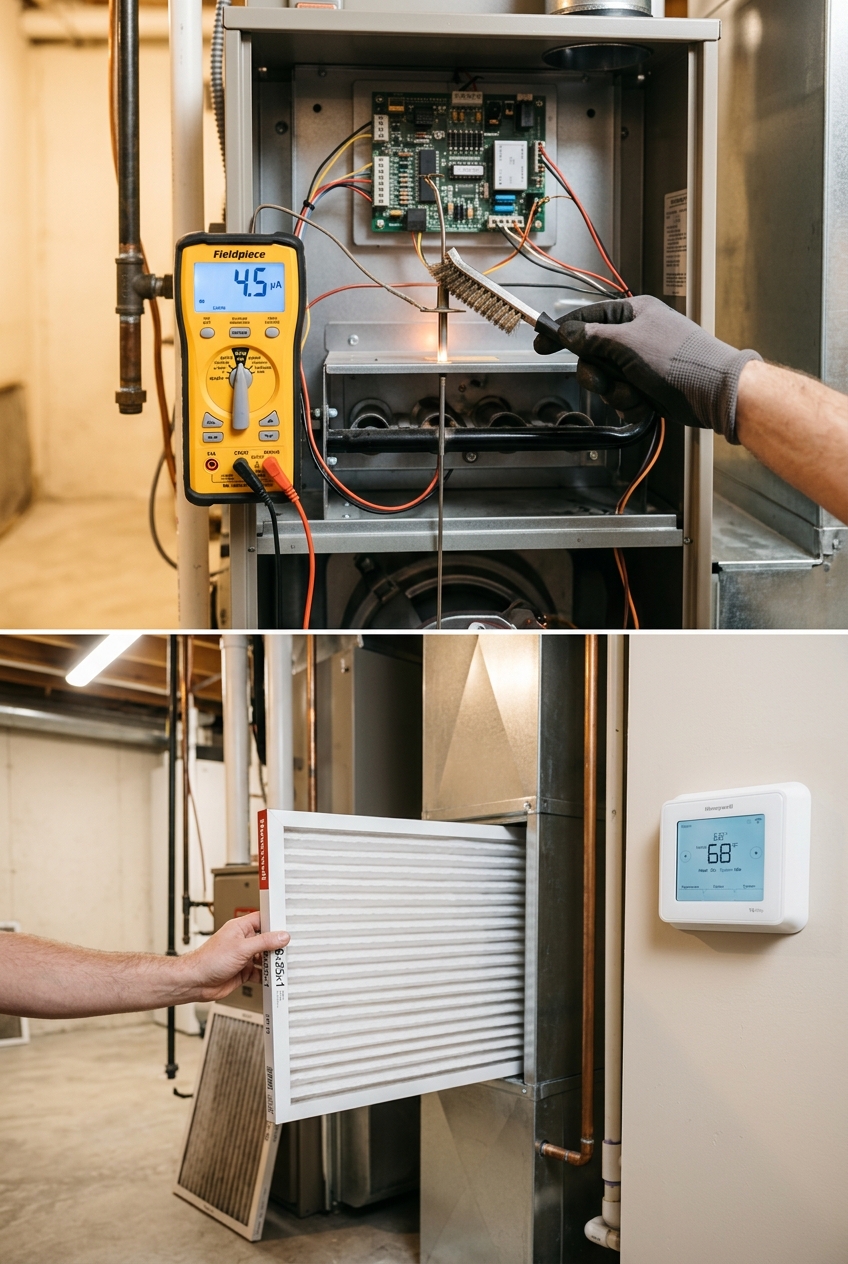
A heavily soiled furnace filter packed with pet dander and dust restricts cubic feet per minute (CFM) airflow across the heat exchanger. When temperatures inside the plenum exceed 180°F–200°F, the bimetallic high-limit safety switch trips open to prevent the heat exchanger from cracking. As a safety protocol, the control board kills gas to the burners while keeping the blower fan spinning at full speed to cool the metal down. Slide out the filter. If light cannot pass through the pleats, replace it immediately with a clean MERV 8 filter and reset power.
Observe the Ignition Sequence and Decipher the LED Error Flash Code
Locate the small round sight glass on the lower blower compartment door. Turn on electrical power and have an assistant call for heat at the thermostat. Peer through the sight glass at the control board LED indicator. Count the flashes (e.g., 3 red blinks usually indicates limit switch open; 1 blink indicates ignition lockout). Next, observe the burner sequence: The inducer draft motor starts $
ightarrow$ the hot surface igniter glows bright orange $
ightarrow$ the gas valve clicks open $
ightarrow$ blue flames ignite. If flames light but extinguish after exactly 3 to 5 seconds, your flame sensor is fouled.
Extract and Polish the Carbon-Fouled Flame Sensor Rod
Shut off power at the furnace toggle switch. Remove the upper burner access panel. Locate the flame sensor: it is a simple thin metal rod with a white ceramic porcelain base held by a single 1/4-inch hex screw on the opposite side of the burner rack from the hot surface igniter. Disconnect the 1/4-inch slip-on wire terminal and back out the screw. Over seasons of combustion, microscopic silica and carbon soot bake onto the rod, creating an electrical insulator. Gently polish the metal rod with a maroon Scotch-Brite pad or dollar bill until the steel shines. Never use sandpaper that sheds aluminum oxide. Reinstall, tighten the screw, and reconnect the wire.
Inspect the Condensate Trap and Clear Safety Float Switches
On modern 90%+ high-efficiency condensing furnaces (identifiable by white PVC exhaust pipes), combustion produces acidic water vapor. If the plastic condensate trap, vinyl drainage tubing, or drain pump reservoir becomes clogged with algae or slime, water backs up into the secondary heat exchanger. An electronic float switch or pressure transducer trips, shutting down the gas valve to prevent basement flooding. Squeeze the vinyl drain tubing and flush the white plastic trap with warm water and vinegar to ensure unobstructed gravity drainage.
🔬 The Physics of Flame Rectification: How a Single Rod Keeps You Safe
Modern gas furnaces rely on a fundamental physical principle known as flame rectification to detect fire safely. A burning hydrocarbon flame contains ionized particles (free electrons and positive ions) capable of conducting electricity. The furnace control board generates an alternating current (AC) voltage (typically 80V to 120V) sent through the flame sensor rod. Because the burner surface area is substantially larger than the sensor rod tip, electrons flow more easily in one direction through the plasma flame than the other. This converts the AC signal into a micro-ampere direct current (DC) signal—typically between 1.5 and 5.0 microamps (µA). When carbon soot coats the rod, electrical resistance spikes, dropping the signal below 1.0 µA. The microcontroller assumes the gas did not ignite and snaps the solenoid valve shut in 4 seconds to eliminate explosive unburned gas buildup.
Master 85+ Non-Toxic Repairs & Save Over $4,000 in Service Calls
This protocol is excerpted from The Home Rescue Bible (2026 Edition). Get instant access to full chemistry formulas, appliance diagnostic wire schematics, and plumbing bypass trees.
Frequently Asked Questions
How often does a furnace flame sensor need to be cleaned?
In average residential conditions, cleaning the flame sensor once every 12 to 24 months during pre-winter maintenance prevents 95% of mid-season ignition lockouts. Homes with pets, nearby laundry detergent dust, or renovation drywall dust should clean it annually.
Can I use standard sandpaper to clean the flame sensor?
No. Avoid standard silica or aluminum oxide sandpaper. Abrasive grit from sandpaper embeds micro-scratches into the stainless steel rod and leaves residual mineral particles that glassify under combustion heat, accelerating sensor failure. Always use an abrasive nylon pad (Scotch-Brite) or 0000 steel wool.
What does a 3-flash red LED error code mean on a Goodman or Carrier furnace?
On most standard Carrier, Goodman, and Lennox furnaces, a continuous 3-flash LED error code signifies an Open Primary High-Limit Switch. This almost always indicates restricted airflow caused by an overdue furnace filter or blocked return air grilles in living areas.
📌 Pin This Field Guide to Your Home Board